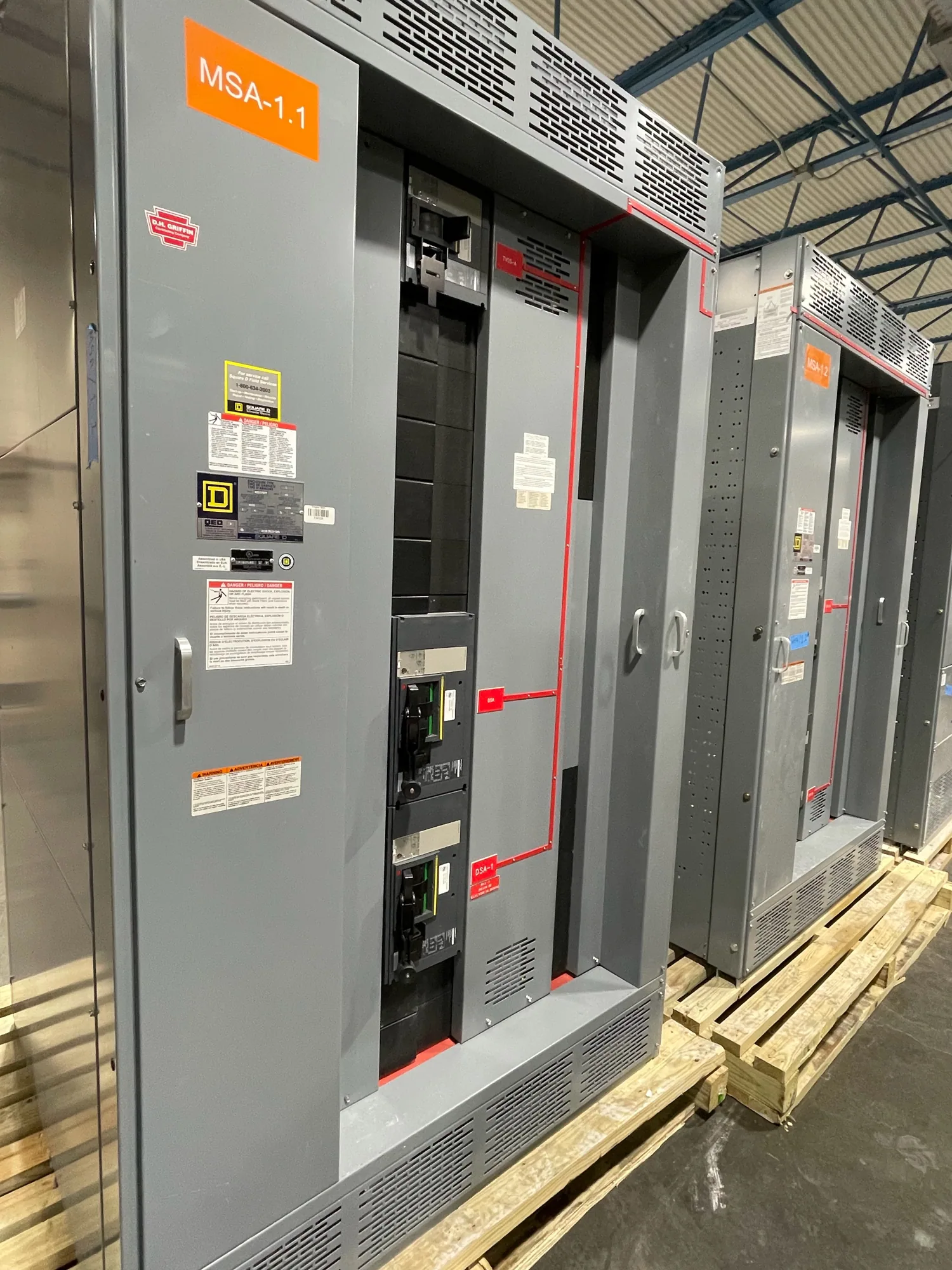
The short answer: different roles in distribution
Panelboards and switchboards both divide incoming electrical power into outgoing circuits, but they are not interchangeable names for the same assembly. A panelboard is commonly used to distribute power to branch circuits or smaller downstream loads. A switchboard typically serves as a larger distribution assembly, often receiving power from a service or transformer and supplying multiple feeders or downstream equipment. The exact function depends on the design.
That distinction is a useful starting point, not a complete selection rule. Equipment application, construction, available ratings, protective devices, installation conditions and governing project requirements all matter. A project engineer should identify the required function and confirm that the proposed assembly is suitable for the system. The manufacturer can then evaluate the specified configuration rather than assuming that a familiar product name settles the question.
How the distribution layout affects the choice
Consider where the equipment sits in the distribution path. If a main distribution point must feed several downstream panels, mechanical loads or other equipment, a switchboard may be appropriate for that role. If the design calls for a panel serving branch circuits in a building area or for a defined load group, a panelboard may be the better fit. These are common applications, not universal boundaries.
One illustrative example is a facility with a central electrical room and several occupied areas. The central assembly could distribute power through feeders to area panelboards, which then supply local branch circuits. Another design might use different equipment or a different arrangement based on the electrical loads and engineering criteria. The responsible engineer must determine the actual topology, protection and equipment interfaces.
Construction, space and configuration
Panelboards and switchboards can differ in physical arrangement, enclosure configuration, incoming and outgoing connections, and the devices accommodated. A panelboard may be specified around a particular set of branch circuits, while a switchboard may be configured to coordinate multiple feeder sections and distribution functions. Do not infer dimensions, access clearances, mounting style or internal layout from the category name alone.
Compare the available installation space with the complete equipment arrangement, including working space and cable or bus access specified for the project. Review whether conductors enter from above or below, how feeders route to other equipment, and whether future circuit capacity is needed. Any allowance for spare positions or expansion should be explicit: space, bus capacity and installed protective devices are different things and must not be treated as equivalent.
Ratings and protective devices require specifics
Both product types must be selected for the project’s electrical system, but their required ratings and device arrangements are determined by the actual design. Provide the system voltage and phase, source information, required current ratings, available fault-current information when established, and the intended protective-device functions. The project engineer should coordinate overcurrent protection and equipment ratings with the system design rather than relying on a generic comparison.
Identify the loads and feeders the assembly must serve, including any special operating or coordination needs. Confirm the required main-device arrangement, branch or feeder device types, neutral and grounding provisions, and connection details against the project documents. Ratings and device compatibility are assembly-specific. A manufacturer should review the requested design and flag information that is missing or needs engineering confirmation before equipment is finalized.
Standards and terminology are not interchangeable
Applicable standards depend on the equipment type and its specific design. UL 891 applies to eligible low-voltage switchboards; whether it applies and whether a particular assembly is listed must be verified for that design. It should not be used as a blanket statement for every switchboard, and it does not apply to medium-voltage switchgear. Nor should switchboards and panelboards be described as though they share identical construction or listing requirements.
Ask which standards and project specifications apply to the proposed equipment, what documentation is required, and whether the offered configuration can meet those requirements. The answer should be checked against the actual assembly and its supplied components. A general product description is not proof of a particular rating, listing or compliance status, so put required conditions in the procurement documents and obtain confirmation during design review.
Common selection mistakes to avoid
A frequent misunderstanding is that one category is always “larger” or automatically handles every higher-capacity application. Product labels alone do not establish capacity, fault performance, number of circuits, future expansion or suitability for a location. Similarly, choosing a panelboard because branch circuits are needed—or a switchboard because several feeders are involved—does not replace review of ratings, layout, protective devices and installation conditions.
Another avoidable problem is treating the equipment as an isolated purchase. Upstream protective devices, downstream loads, conductors, connection points and available installation space affect whether the assembly fits the project. If the design changes, revisit those interfaces rather than assuming the original selection remains valid. Qualified personnel should handle installation, testing and maintenance under applicable safety procedures.
Information to share before requesting a proposal
To support a useful equipment review, provide the one-line diagram, equipment schedule and project specification when available. Include system voltage and phase, source and feeder arrangement, required ratings, protective-device requirements, enclosure and installation details, and the intended downstream loads. Identify the project location, requested delivery window and any documentation or standards requirements so availability and schedule can be evaluated for the actual order.
Then ask the engineer and manufacturer to confirm the proposed product type, configuration, ratings, standards applicability, interfaces and any open assumptions. For an order from South Carolina Switchgear Builders, equipment is custom to specification, US-built with all-American components, and shipped nationwide; availability and lead times depend on the order and must be confirmed. With those details settled, the selection can support the distribution plan rather than rest on terminology alone.