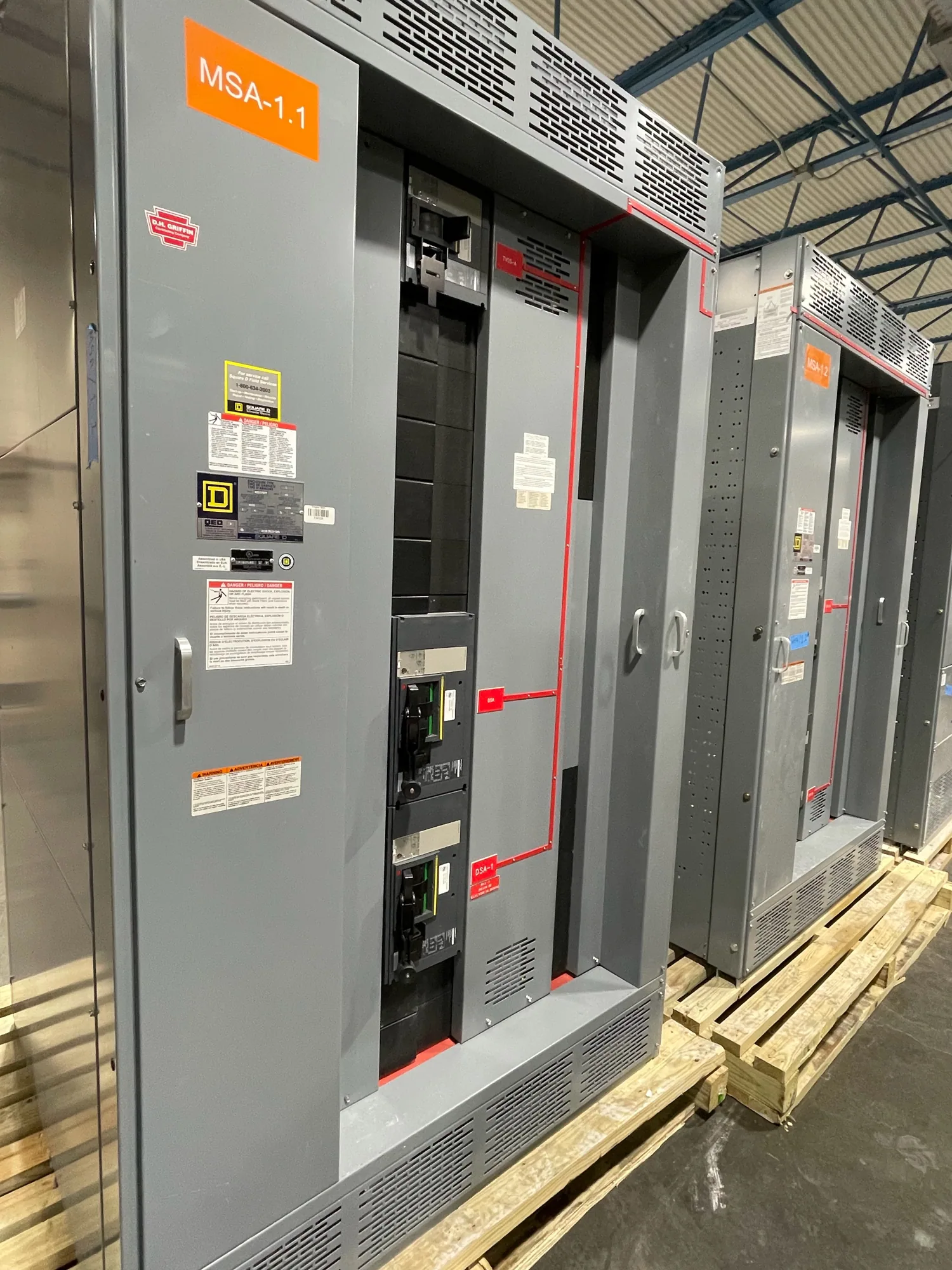
Start with the project, not a presumed local template
For a Goose Creek-area project, switchgear planning begins with the electrical design and the specific site—not assumptions about what nearby facilities use. A project may involve a utility-service interface, industrial loads, motor-driven equipment, or a building expansion. Each possibility brings different requirements. The owner, electrical engineer, utility representative, and equipment manufacturer should align on scope before selecting an assembly.
South Carolina Switchgear Builders manufactures new switchgear and switchboards to specification in the United States and ships nationwide. Buyers can discuss a project from Goose Creek without assuming the manufacturer has a local office or facility. Availability and actual lead times depend on the order and must be confirmed. Begin early enough to resolve design questions and coordinate equipment delivery with the construction schedule.
Define the service and distribution arrangement
Share the project’s one-line diagram, service characteristics, system voltage, and intended distribution arrangement. Identify whether the request concerns low-voltage switchboards, medium-voltage switchgear, or another specified assembly. These terms describe different equipment; a switchboard is not interchangeable with every type of switchgear. The responsible engineer should establish the equipment scope and confirm system compatibility rather than relying on a broad product label.
Clarify the utility or upstream source interface, transformer information where applicable, downstream distribution, and planned future connections. Document available fault current at the equipment location if known, along with the study basis and relevant assumptions. Do not select interrupting capacity or assembly withstand and short-circuit current ratings from a generic rule of thumb. The engineer must determine the required values for the actual system and verify that the proposed design addresses them.
Coordinate ratings, access, and installation conditions
Electrical ratings are only part of a usable specification. Establish the equipment location, room or enclosure constraints, access route, door and aisle clearances, cable entry direction, conduit space, and available working area. Confirm dimensions and handling constraints with the project team before drawings are finalized. Delivery planning should account for how the equipment will reach its installation position, not just whether a truck can reach the site.
Ask the design team to identify environmental conditions and any project-specific enclosure, construction, or operating requirements. Confirm the intended incoming and outgoing connections, metering or protective functions, and coordination with upstream and downstream devices. Listing, testing, standards, ratings, and delivery dates must be verified against the actual specification and supplied equipment. UL 891 may apply to eligible low-voltage switchboards, but applicability and assembly listing depend on the specific design; it does not establish requirements for medium-voltage switchgear.
Consider motor control centers where the scope fits
For a hypothetical chemical processing project, the team might evaluate whether a motor control center (MCC) suits a group of motor loads. That decision depends on the electrical design, operating arrangement, space, maintenance approach, and project requirements—not simply on the industry name. An MCC may be considered alongside distribution equipment, but the engineer should define the boundary between motor control, feeders, and the broader switchgear or switchboard scope.
Prepare a motor schedule with the information available, such as motor characteristics, starting method, control requirements, and expected operating relationships. Identify which functions belong in the MCC and which require separate equipment or coordination. Ask how the proposed arrangement affects footprint, cable routing, control interfaces, and future changes. These are design questions for the project engineer and manufacturer to resolve against the actual load data; no particular configuration should be presumed suitable in advance.
Build an RFQ that supports an accurate proposal
A useful request for quotation (RFQ) includes the latest one-line diagram, equipment schedule, project specifications, system voltage, available fault-current information, and requested ratings. Add preferred lineup arrangement, approximate dimensions, connection details, control and metering scope, and any known site or environmental constraints. Mark unresolved items clearly so the engineering team can distinguish confirmed requirements from assumptions requiring review.
Include the project location in Goose Creek, South Carolina, the required submittal and approval milestones, and the date equipment is needed on site. State who will review drawings and respond to technical questions, and identify coordination points with the utility, engineer, contractor, and other equipment suppliers. Custom equipment is made to specification; a complete RFQ helps expose conflicts before fabrication planning and allows availability and lead time to be checked for the actual order.
Coordinate delivery and close open decisions
Before an order proceeds, align the approved drawings, final ratings, connection interfaces, and responsibility for any remaining engineering decisions. Confirm the equipment configuration, applicable listing or testing requirements, and expected delivery schedule directly against the order. Short lead times may be available, but timing depends on the specified equipment and current order conditions; obtain confirmation rather than planning around an assumed date.
For delivery to Goose Creek, coordinate the receiving contact, site access, unloading method, storage conditions, and sequence with the construction team. Verify that the route and installation area are ready for the equipment as configured. Installation, testing, and maintenance should be handled by qualified personnel under applicable safety procedures. Clear project data and timely reviews give the manufacturer and site team a practical basis for coordinating new equipment from specification through delivery.