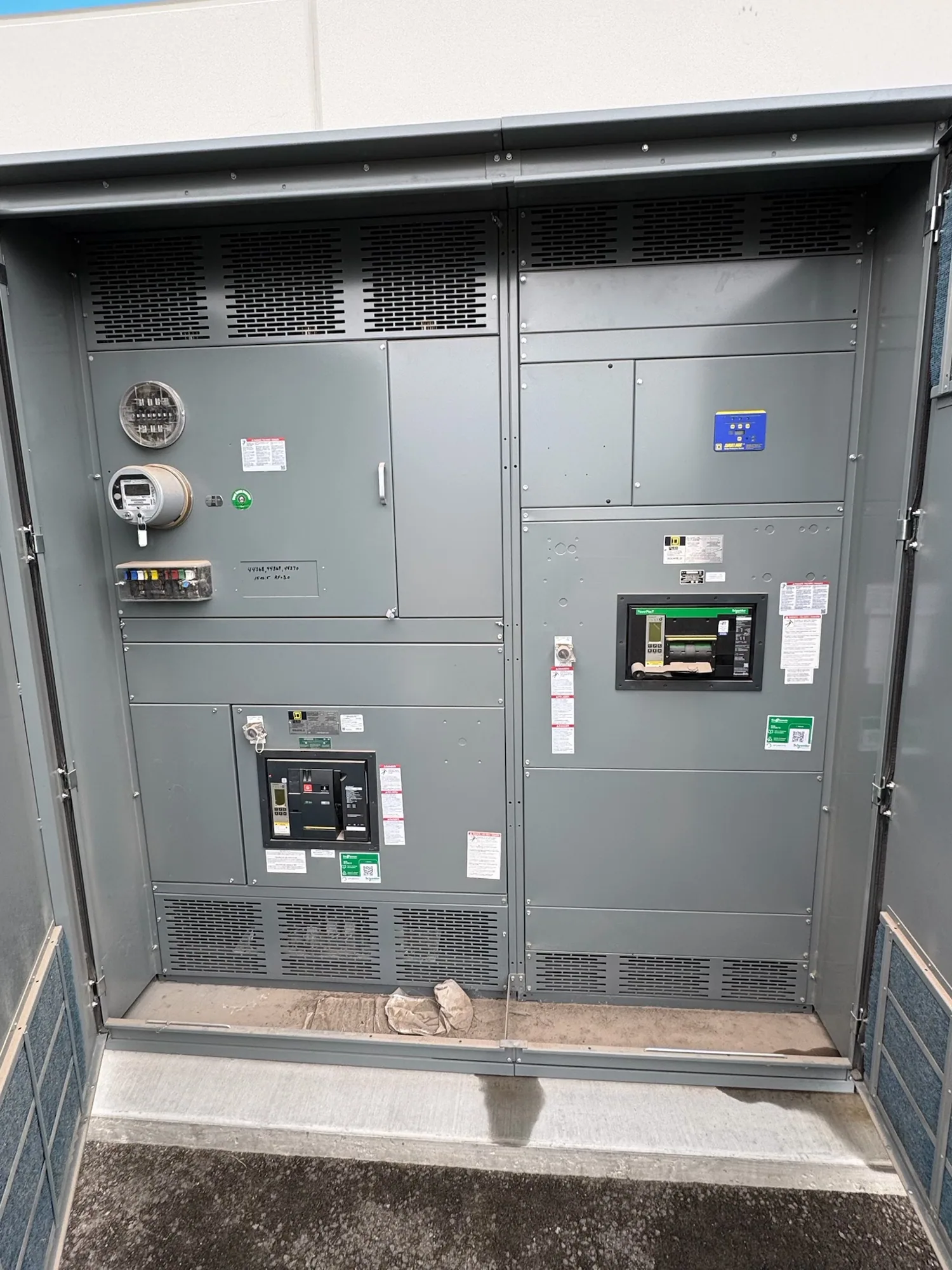
Where medium-voltage switchgear fits in a data center
For a data center with concentrated IT loads, substantial cooling demand, and planned growth, medium-voltage switchgear may connect incoming sources to transformers or downstream distribution. Its role depends on the one-line diagram and the facility’s chosen architecture. It is not a substitute for specifying the complete path from the utility or other source through transformation, backup systems, and the loads the project intends to serve.
Redundancy approaches vary. A project might use separate source paths, sectionalized distribution, backup generation, or a combination, but those choices must be evaluated by the responsible electrical engineer. Switchgear configuration should reflect the intended normal and alternate operating states, including how sources are isolated and what loads remain supported during planned or unexpected outages. Equipment alone cannot establish that an overall facility meets a particular availability objective.
Coordinate sources, feeders, and protective interfaces
Start with the project one-line diagram and identify each incoming source, bus arrangement, outgoing feeder, transformer connection, and planned tie. Document which devices are expected to open or close in each operating mode. If generators or other alternate sources connect to the distribution system, define their interfaces and operating sequence with the project engineer; do not assume a particular transfer scheme or control function is included with the switchgear.
Protection depends on the system and its coordination study. Provide the engineer’s requirements for protective relays, instrument transformers, trip and close circuits, metering, alarms, communications, and control power, as applicable to the design. Confirm which functions belong in the equipment and which are furnished by other project parties. Relay selection and settings must be coordinated with source characteristics and downstream protection rather than inferred from a general data center application.
Confirm voltage class and insulation requirements
“Medium voltage” is not a complete equipment specification. State the nominal system voltage and ask the responsible engineer to confirm the equipment’s required maximum voltage and insulation level for the actual system and conditions. Identify frequency, grounding arrangement, phase configuration, and any other project-specific electrical requirements. A stated voltage class alone does not establish that a proposed assembly is suitable for a particular installation.
Isolation and switching requirements also need explicit treatment. Describe the desired arrangement for isolating sections or feeders, the operating methods anticipated, and any interlocks or access provisions required by the design. Ask how the proposed construction addresses the specified environment and installation constraints. Ratings, clearances, insulation details, and applicable standards must be reviewed against the actual equipment specification; do not rely on assumptions based solely on a product category.
Plan capacity in phases without losing coordination
Data center projects may bring capacity online in stages as buildings, data halls, or electrical rooms are completed. Share the expected phases, initial and future feeder needs, reserved spaces, and the point at which later equipment is expected to be added. The design team should determine whether the initial arrangement supports the planned sequence and whether future work requires outages, additional protection studies, or changes to source coordination.
Phasing creates practical tradeoffs. Providing for future sections can affect the initial footprint, connections, controls, and procurement scope, while installing only immediate requirements may make later expansion more disruptive. Ask the manufacturer to quote the defined initial configuration and clearly identify any specified provisions for future work. Confirm dimensions, access, cable entry, shipping splits, and interface boundaries with the project team before layout and procurement are finalized.
Make monitoring and maintainability project-specific
Monitoring needs should follow the facility’s operating and control strategy. Identify required measurements, local indications, alarms, communications protocols, and connections to supervisory systems, then confirm which are part of the switchgear supply. Avoid treating a general request for “remote monitoring” as a complete scope: the data points, interfaces, network responsibilities, and control functions require agreement among the owner, engineer, controls provider, and equipment supplier.
Maintainability also depends on the physical room and operating procedures. Provide room dimensions, equipment access routes, cable and bus interfaces, environmental conditions, and any known outage constraints. The project team should review clearances, access, isolation practices, and the ability to perform planned work safely. Installation, commissioning, testing, and maintenance are separate project activities for qualified personnel following applicable procedures; confirm who is responsible for each before purchase.
Prepare a useful equipment request
A strong request for quotation includes the one-line diagram, nominal and required equipment voltage information, system configuration, source and feeder list, preliminary load or capacity schedule, protection and control requirements, and applicable project specifications. Add the physical arrangement, indoor or outdoor application as defined by the design, cable entry preferences, environmental conditions, phasing plan, and requested documentation. Mark open decisions clearly so they can be resolved rather than silently assumed.
South Carolina Switchgear Builders manufactures new switchgear and can supply custom equipment to specification, with nationwide shipping. Availability and actual lead times depend on the order and must be confirmed. Before purchase, align the equipment scope, submittal review, interfaces, delivery expectations, and responsibilities for engineering, installation, and field work. That coordination gives the manufacturer a clearer basis for proposing equipment and gives the data center team a better path from an approved design to an executable procurement package.