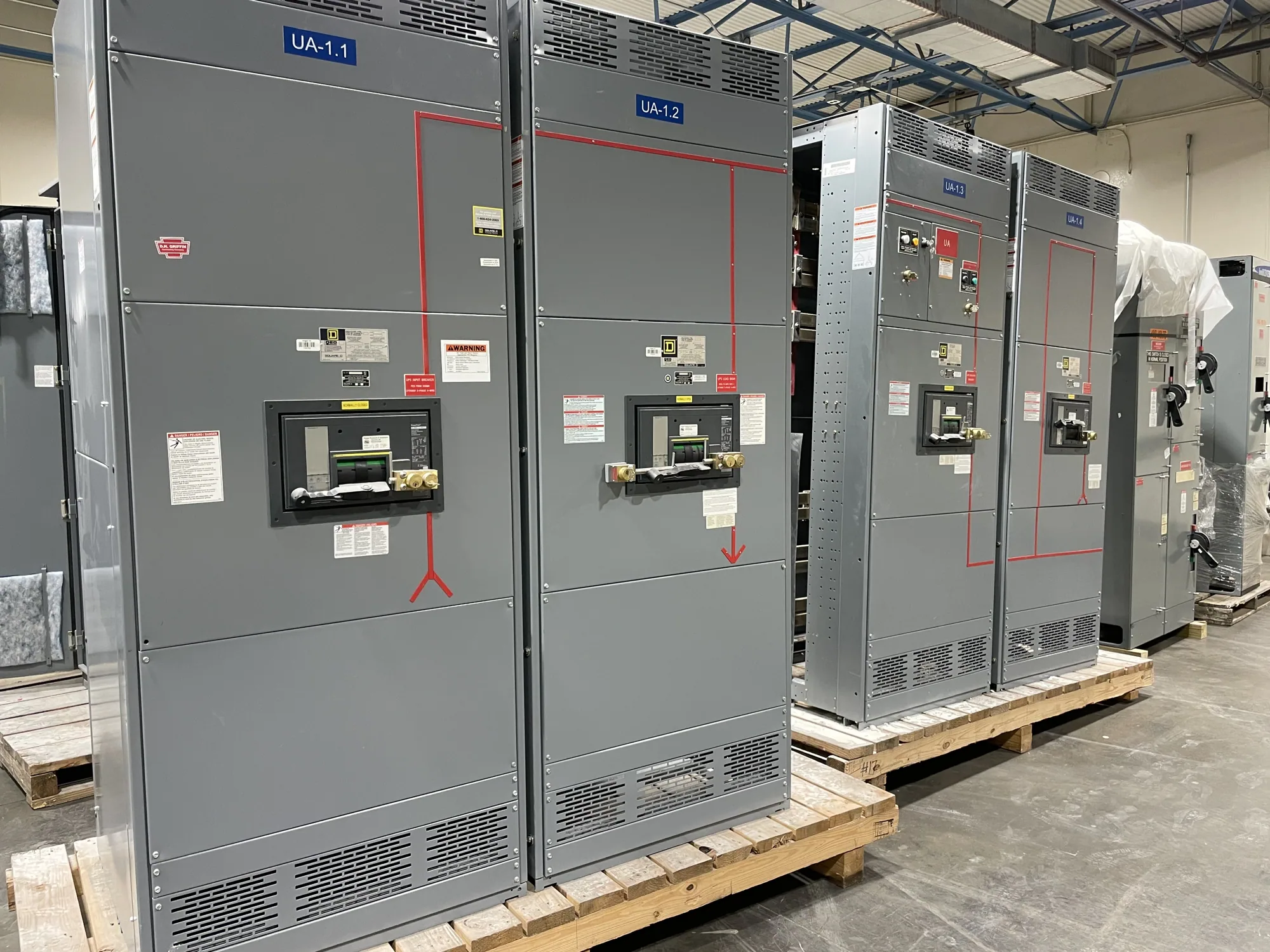
What available fault current means
Available fault current is the calculated or supplied current that an electrical source can deliver at a particular point in a system when a fault occurs. The value is tied to that location and to the system configuration and assumptions used in the calculation. It is not a single fixed value that describes every point in a facility.
Engineers use this information when evaluating whether electrical equipment can safely handle the conditions anticipated at its installation point. The term often appears in discussions of short-circuit current, interrupting ratings, and equipment withstand capabilities. It describes the fault-current exposure to be considered; it does not, by itself, state what rating an assembly has or establish that a design is suitable.
Why the point in the system matters
Available fault current generally differs across a distribution system. Source characteristics, transformer data, conductor length and impedance, and the arrangement of connected equipment can affect the calculated value. A value at a service point should not automatically be treated as the value at a downstream switchgear lineup. The project engineer determines the appropriate system model and calculation point.
For a new low-voltage switchgear project, the equipment location and the system conditions at that location are key inputs to rating review. If the source, transformer, feeder path, or operating arrangement changes, the previous calculation may no longer represent the planned installation. Buyers should identify the design basis and have the responsible engineer confirm that the supplied information matches the current one-line diagram and project configuration.
How it relates to equipment ratings
Available fault current is commonly compared with equipment ratings, but the terms are not interchangeable. An interrupting rating concerns an overcurrent device’s ability to interrupt fault current under specified conditions. An assembly’s short-circuit current rating or withstand capability addresses the assembly-level conditions defined for that equipment. The responsible engineer must evaluate the applicable ratings and coordination requirements for the complete design.
A suitable comparison cannot be made by looking at one number in isolation. The system voltage, device characteristics, assembly configuration, and applicable conditions all matter. Ratings and construction details are design-specific and should be verified against the actual equipment documentation. For a low-voltage switchgear application, confirm the relevant short-circuit rating and device information rather than assuming that a rating for one component automatically describes the entire lineup.
A conceptual example—and a common mistake
Consider a hypothetical project in which an engineer has calculated available fault current at a planned switchgear connection point. The value is an input for reviewing equipment suitability; it is not a rating assigned to the switchgear. The engineer would compare the system conditions with the specified equipment and device ratings, while accounting for the project’s actual configuration. No rating can be inferred without the engineering data and product specification.
A common mistake is to treat available fault current, interrupting rating, and assembly withstand rating as synonyms. Another is to use a value from a different location or an outdated study without confirming whether source and feeder assumptions still apply. A further distinction is that a fuse or circuit breaker’s interrupting capability does not alone establish the suitability of the complete switchgear assembly. Each term answers a different question.
Information to confirm before specifying equipment
Before requesting a new equipment configuration, provide the manufacturer with the project’s current one-line diagram and the available fault-current value at the proposed connection point, including its source and calculation basis when available. Identify system voltage, source and transformer information, feeder details, and relevant operating arrangements. The project engineer should confirm which data are final and which remain subject to change.
Also clarify the required equipment type, installation context, and project-specific ratings or documentation. Ask which assembly and device ratings apply to the proposed configuration, and what details the manufacturer needs to evaluate it. If an assembly listing or a particular standard is a project requirement, request confirmation for the actual design; applicability depends on the equipment and configuration. Availability and delivery timing likewise need confirmation against the order.
Turn the definition into a project check
Use available fault current as a location-specific engineering input, not as a stand-alone product specification. Have the responsible engineer verify the calculation point and assumptions, then coordinate the resulting equipment requirements with the manufacturer before finalizing a new switchgear order. This helps keep the study, one-line diagram, and requested configuration aligned as the project develops.
South Carolina Switchgear Builders manufactures new equipment to specification, with US-built equipment, all-American components, and nationwide shipping. Discuss the project’s documented requirements and confirm the proposed configuration, ratings, applicable listing details, availability, and delivery schedule for the actual order. Qualified personnel should handle installation, testing, and maintenance under applicable safety procedures.