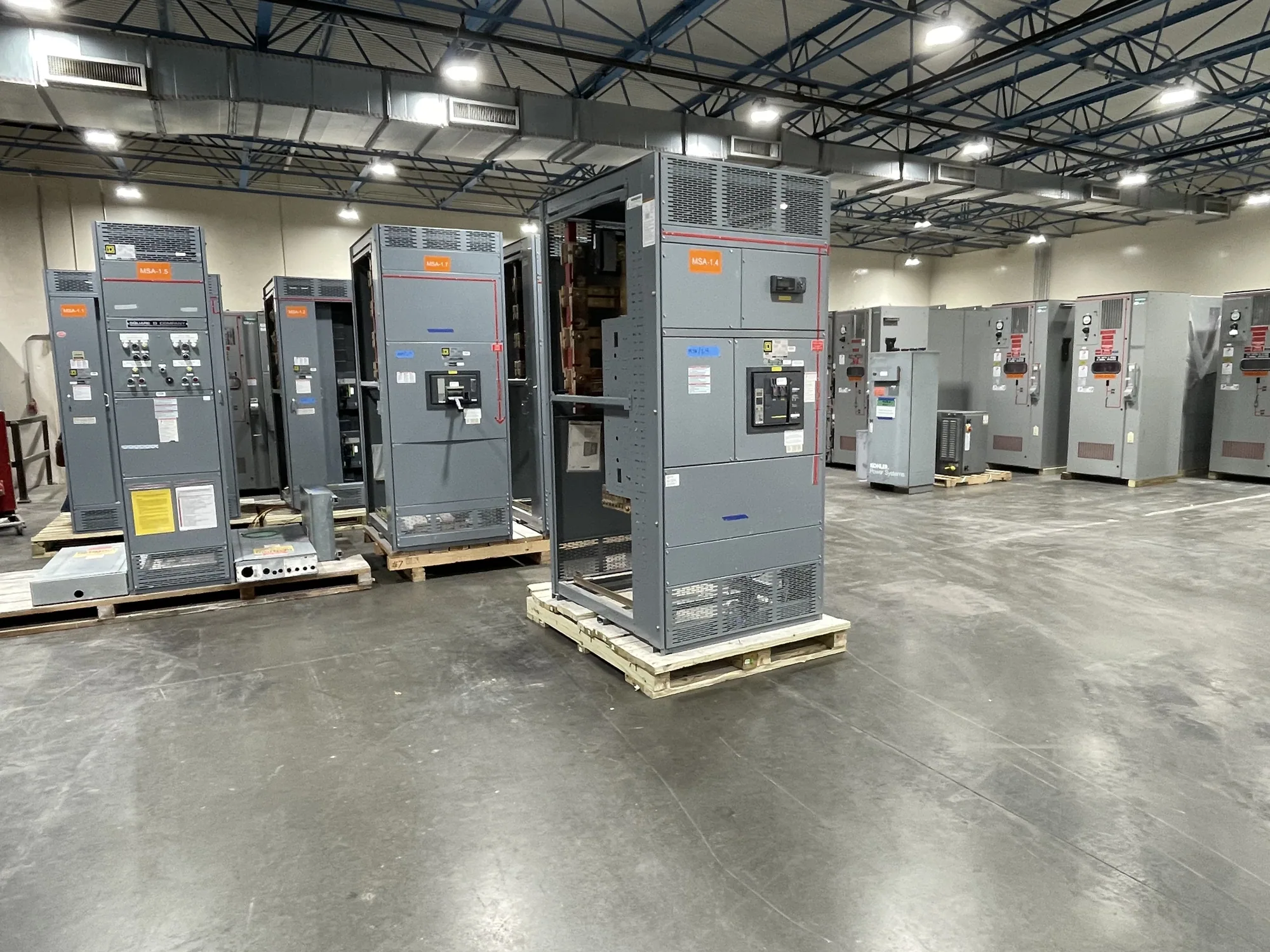
Why ratings matter in an arc-resistant design
Short-circuit ratings help determine whether proposed switchgear is suitable for the electrical system at its point of installation. For arc-resistant switchgear, they must be considered alongside the specific arc-resistant design and the conditions under which that design was evaluated. An arc-resistant designation does not, by itself, establish the equipment’s interrupting capacity or short-circuit withstand capability.
Three related values are important to distinguish: available fault current at the equipment location, the interrupting rating of devices that must clear a fault, and the assembly’s applicable short-circuit current or withstand rating. Their relationship depends on the equipment design and system protection. A project engineer should establish the required values and confirm that the proposed equipment documentation supports the intended application.
Start with available fault current at each location
Available fault current is not necessarily the same throughout a facility. It can vary by bus or distribution point based on the source, transformers, conductors, system arrangement and other project conditions. The responsible engineer should calculate or otherwise determine the applicable fault current for each proposed switchgear location, using project-specific information and the appropriate engineering methods.
Compare that result with the ratings of the complete proposed assembly and its fault-interrupting devices, as applicable. Do not select equipment from a service voltage or a general product description alone. If the system may change—for example, through a different transformer or source arrangement—ask whether the resulting fault-current assumptions remain valid. The governing design values and required margin belong in the project documents for review.
Confirm the assembly and device ratings together
A circuit breaker’s interrupting capacity describes its ability to interrupt fault current under specified conditions. The switchgear assembly’s short-circuit current or withstand rating addresses the assembly’s capability under its stated rating conditions. These are not interchangeable statements. The specification and submittals should identify the applicable values, the devices involved, and any conditions or limitations needed to understand the complete equipment arrangement.
Have the manufacturer confirm that the offered lineup, bus arrangement, protective devices and requested arc-resistant configuration are supported together by the relevant design documentation. A rating shown for one component or a different lineup should not be assumed to apply to another assembly. Likewise, do not assume an arc-resistant configuration preserves every rating or option available in a different arrangement; request equipment-specific confirmation before approval.
Arc-resistant performance depends on tested configuration
Arc-resistant performance is associated with a particular equipment design and specified installation conditions, not with a broad label detached from the assembly. The responsible team should identify the required accessibility classification or other applicable project criteria, then verify that the proposed design supports them. Confirm which compartments and operating conditions are covered, and identify any exclusions in the product documentation.
Installation details also matter. Room clearances, access, exhaust direction, barriers, cable entry, lineup placement and adjacent construction may affect whether the documented arrangement can be used as intended. The engineer and equipment supplier should review these details against the applicable design limits. Do not infer arc-resistant coverage for external cables, connected equipment, or work practices unless the relevant documentation specifically addresses them.
Illustrative automotive manufacturing scenario
Consider an automotive manufacturing project planning a new switchgear lineup for a production area. The available fault current, system voltage, transformer data and required accessibility are not provided here, so no rating or equipment selection can be concluded. The project engineer would determine fault current at the lineup, establish the protective-device requirements and document how the electrical system is expected to operate.
Next, the buyer and engineer would compare those requirements with a proposed assembly’s documented ratings and arc-resistant configuration. They would resolve practical tradeoffs such as lineup footprint, cable access, room arrangement, future expansion and the protection scheme. If any input remains uncertain, it should be clearly identified as an assumption for engineering review—not converted into a nominal rating by guesswork.
Information to include in a specification request
- System voltage, frequency, one-line diagram and intended equipment location.
- Calculated available fault current at the installation point, with the responsible engineer’s stated assumptions.
- Source and transformer information, protective-device requirements, and any known operating or future system configurations.
- Required assembly and interrupting ratings, together with requested arc-resistant criteria and applicable accessibility conditions.
- Room dimensions, lineup arrangement, cable entry, clearances, environmental conditions and project-specific interface requirements.
- Requested submittals, rating documentation, exclusions, testing scope and any applicable listing requirements to be confirmed for the specific design.
Ask the supplier to identify which documents substantiate each requested rating and which installation or configuration limits apply. Submit the one-line diagram, fault-current study or design values, preliminary layout, schedule needs and specification for review. Availability and actual lead times depend on the order and must be confirmed. Clear, coordinated inputs help the project team evaluate new equipment against both the electrical system and the documented arc-resistant design.