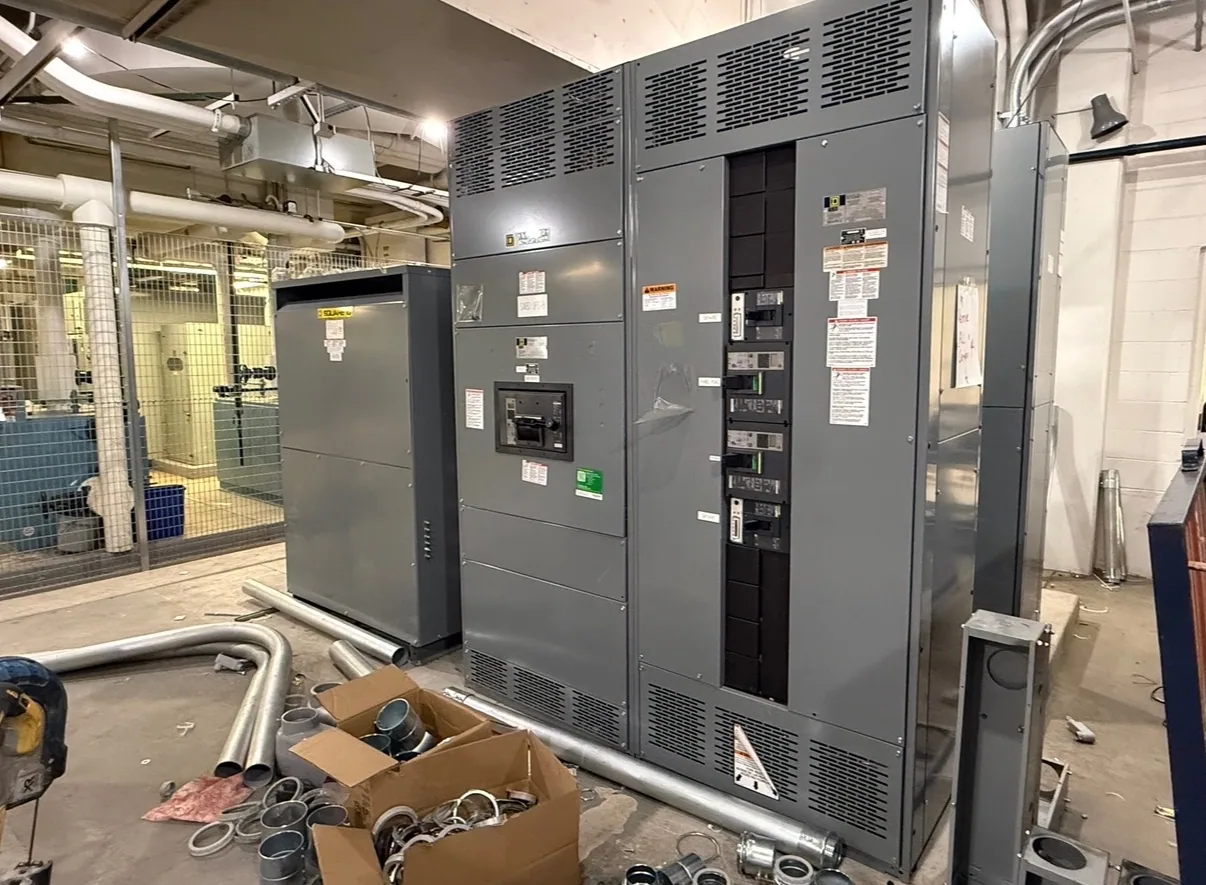
Start with fault current at the equipment location
Outdoor switchgear short-circuit ratings are meaningful only in relation to the electrical conditions where the equipment will be installed. The responsible project engineer determines the available fault current at the relevant point in the system and evaluates whether the proposed equipment is suitable for that duty. The value is not safely inferred from a facility’s size, service voltage, or equipment appearance.
A project may include more than one distribution point, and fault-current conditions can differ between them. Utility or source characteristics, transformer data, conductor impedance, and system configuration can affect the calculation. Design changes can also alter the result. Provide the current one-line diagram and known source information so the rating review reflects the intended system rather than an outdated or incomplete arrangement.
Distinguish component interruption from assembly withstand
Interrupting capacity describes the ability of a protective device, such as a circuit breaker, to interrupt a specified fault under applicable conditions. An assembly short-circuit current or withstand rating addresses the switchgear assembly’s ability to withstand or manage the specified fault duty as designed. These concepts are related, but they are not interchangeable. A breaker rating by itself does not establish the rating of the complete assembly.
Ask the equipment supplier to identify the rating basis for the exact proposed configuration, including the applicable devices and any conditions or limitations. Confirm how the rating applies to the bus, protective devices, and assembled lineup. The responsible engineer should review protective-device selection and coordination alongside the equipment data. Do not assume a rating carries over to a changed lineup, substituted component, or different arrangement without confirmation.
Coordinate ratings with outdoor installation details
Outdoor placement adds installation conditions that should be reviewed with the electrical design. Enclosure selection, entry locations, ventilation or moisture-control provisions, and the foundation interface can affect the specified equipment configuration. Those details do not replace fault-current analysis, but they can determine whether the proposed arrangement fits the site and remains accessible for qualified inspection and maintenance.
Confirm the planned mounting surface, available footprint, cable routing, conduit entry direction, working clearances, and access path before equipment is released for manufacture. Ask which environmental and enclosure characteristics are included in the offered design, and which site measures are assumed. Keep the short-circuit rating discussion distinct from enclosure ratings: each requirement needs its own specification and confirmation for the actual equipment.
Evaluate system changes and practical trade-offs
When calculated available fault current exceeds an equipment rating, the response is an engineering decision—not a reason to select a larger number without review. The engineer may evaluate source or system arrangements, protective-device choices, or equipment configurations, considering their effects on coordination, operation, footprint, and project cost. Any proposed change should be checked against the full system design and confirmed for the specific assembly.
Conversely, specifying an unnecessarily high rating without regard to the actual application can constrain equipment options or increase project demands. The objective is a documented match between calculated fault duty and equipment capabilities, with suitable margin and design assumptions determined by the responsible engineer. Record the source data, calculation basis, and system configuration used, particularly when future expansion or alternate operating modes are part of the project.
Illustrative manufacturing application
Consider an automotive manufacturing facility planning new outdoor distribution equipment. Its production loads, utility source, transformer arrangement, and planned operating modes are not specified here, so no fault-current value or required rating can be assumed. The project engineer would establish available fault current at the proposed switchgear location and identify the operating configuration or configurations that govern equipment selection.
The buyer can then ask whether the proposed assembly and protective devices meet the documented duty, what configuration the rating applies to, and what assumptions need to remain unchanged. The team should also coordinate the equipment footprint, foundation, cable connections, and access requirements with the site plan. A qualified engineer must perform or review calculations and standards applicability for the actual project.
Prepare a useful specification package
For a focused review, provide the equipment voltage class, one-line diagram, source and transformer information, conductor details available to the project team, calculated fault current and calculation basis, and the intended system configuration. Include protective-device requirements, feeder or lineup arrangement, outdoor installation conditions, connection locations, and any planned alternate sources or future expansion. Mark unknowns explicitly rather than filling them with assumed values.
Ask for equipment-specific documentation identifying the proposed assembly configuration, applicable short-circuit and interrupting ratings, rating conditions, and any exclusions. Confirm whether testing, listing, or standards requirements apply to the particular design; applicability must be verified rather than presumed. If the project specification requires a particular document or review milestone, state that requirement and identify who will approve the submittal.
Coordinate submittals before release
South Carolina Switchgear Builders manufactures new switchgear to specification, with US-built equipment, all-American components, and nationwide shipping. Availability and actual lead times depend on the order and must be confirmed. Share the electrical and installation requirements early so the proposed configuration can be reviewed against the project documents before approval and release.
During submittal review, compare the approved drawings and equipment data with the final one-line diagram and fault-current study. Resolve differences in ratings, protective-device selections, lineup arrangement, or site interfaces before manufacture. Installation, testing, and maintenance should be handled by qualified personnel using applicable safety procedures. This coordination gives the project team a clear record of the rating basis and the outdoor configuration being supplied.