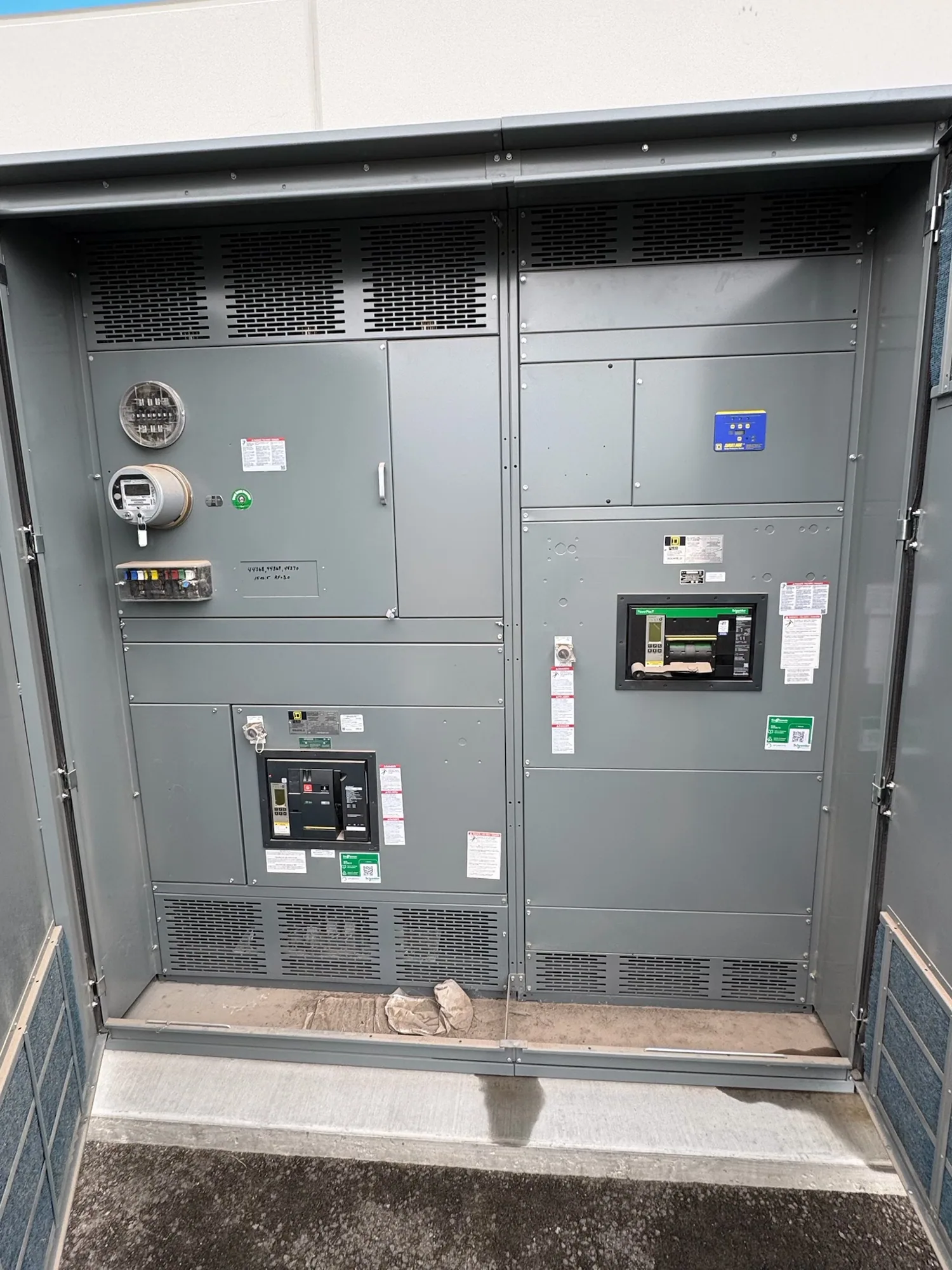
Start with the panelboard’s role
A power distribution panelboard divides an incoming supply into branch circuits and provides spaces for compatible protective devices. Its voltage rating is one element of a coordinated design—not a stand-alone answer to whether a panel suits a project. Confirm the intended function, location in the distribution system, and connected loads with the responsible electrical engineer before selecting equipment.
Panelboards are distinct from switchgear and switchboards, even though all can be part of a building’s distribution system. This page concerns branch-circuit panelboards. Equipment construction, application, and governing requirements depend on the product category and specific design. Do not transfer a rating or standard from another equipment type by analogy; identify the applicable product requirements for the exact panelboard assembly.
Separate nominal voltage from equipment rating
Nominal system voltage describes the electrical system the panelboard is intended to serve. The equipment’s marked voltage rating and any applicable maximum-voltage designation are equipment characteristics that must be checked against that system. They are related, but they are not interchangeable terms. A project specification should state the actual system voltage and configuration rather than rely on an informal label such as “standard panel.”
Also establish whether the source is single-phase or three-phase, the number of wires, and how the system is grounded. These details affect which panelboard configuration and devices may be suitable. The engineer should verify compatibility with the source and connected loads, including any relevant line-to-line and line-to-neutral voltages. Do not infer those values from a building type or from a panel’s voltage class alone.
Consider insulation and system conditions
Insulation design supports separation between energized parts and between those parts and grounded enclosures. The required insulation characteristics depend on the equipment design, rated voltage, system configuration, and applicable requirements. Ask the manufacturer to identify the proposed equipment ratings and documentation for the specified application. The project engineer remains responsible for determining whether the offered configuration is appropriate for the installation conditions.
System voltage matching does not replace review of other electrical ratings. Available fault current, protective-device interrupting ratings, panelboard short-circuit ratings where applicable, and upstream coordination all require attention. The design team should assess these values using project-specific information and confirm that the panelboard and selected devices are suitable together. A voltage match alone does not establish adequate fault performance or protection.
Coordinate branch circuits and panel placement
Branch-circuit capacity and the number and type of protective devices influence panel selection, but they should be considered alongside voltage and configuration. Provide the expected loads, circuit schedule, spare-space needs, and any special device requirements for review. Panel location can also affect conductor routing, environmental conditions, access, and coordination with upstream and downstream equipment; the project documents should identify relevant constraints.
For a pharmaceutical or biotechnology facility, for example, a design team might be evaluating a panelboard for a process area with dedicated equipment loads and separate building services. The actual voltage, phase, grounding arrangement, fault current, load schedule, and environmental conditions are unknown until established by the project. A qualified engineer should calculate and review those values, then confirm the applicable standards and equipment requirements. The facility type by itself does not determine a panelboard rating.
Make the specification answerable
Before requesting a proposal, provide the nominal system voltage, phase and wire arrangement, grounding method, and source information. Include available fault current or the basis for its determination, required protective-device types, load and circuit schedules, and any known upstream coordination criteria. State the installation location and environmental considerations, and identify project drawings or specification sections that define applicable requirements.
Ask the supplier to confirm the proposed panelboard’s voltage rating, configuration, compatible device options, and relevant fault ratings against the supplied project data. Clarify what documentation accompanies the equipment and which design-dependent requirements remain subject to engineer review. Listing, testing, standards applicability, and assembly ratings must be verified for the actual design; do not assume a particular certification applies to every panelboard.
Resolve boundaries and coordinate submittals
A complete equipment specification should distinguish included panelboard components from items supplied elsewhere. Identify whether the scope includes the enclosure, bus arrangement, main protective device, branch devices, metering, and accessories—or state clearly when these are by others. Confirm dimensions, cable entry needs, termination requirements, and any project-specific labeling or documentation expectations before the design is finalized.
Submit the one-line diagram, panel schedules, load information, fault-current data, and relevant installation constraints for review. Resolve discrepancies between drawings and written requirements before approval, and document any requested deviations. Availability and delivery timing depend on the final order and must be confirmed. With system data, ratings, and scope aligned, the project team can evaluate a new panelboard against its intended branch-circuit application and coordinate procurement with the wider distribution design.