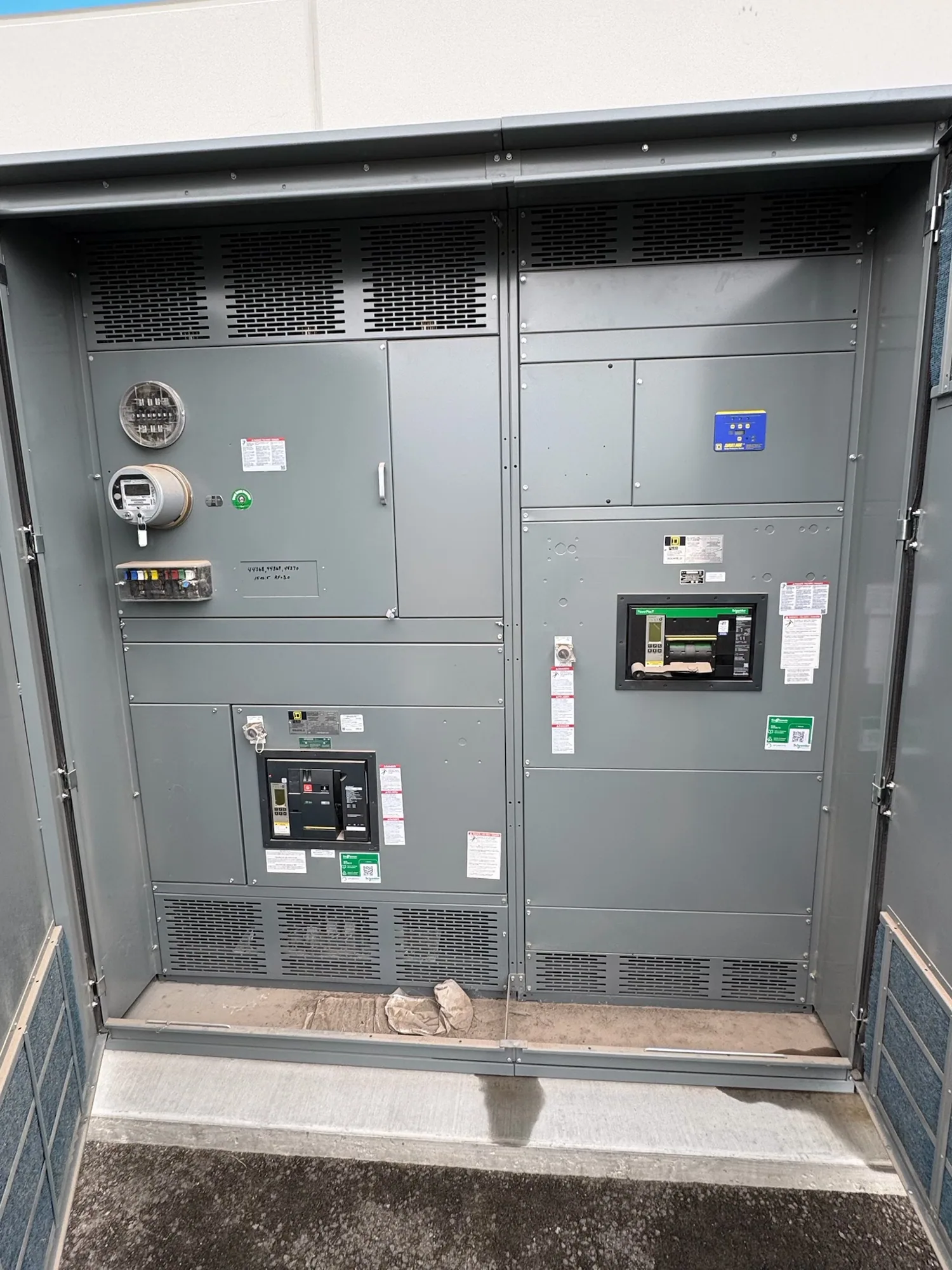
Where short-circuit ratings matter at the service entrance
Service-entrance switchgear is part of the main distribution system, so its short-circuit ratings must be considered against the fault current that may be available at the equipment’s line terminals. That value depends on the source and the electrical system between the source and the point being evaluated. It is not a number that can be selected from a generic product description or assumed from the service voltage alone.
Several related ratings may appear in drawings and specifications. A protective device’s interrupting capacity concerns its ability to interrupt a fault under stated conditions. The assembly’s short-circuit current rating or withstand rating addresses the equipment assembly under specified conditions. These terms describe different parts of the evaluation; they are not interchangeable. The responsible engineer should identify the applicable rating basis and confirm the actual proposed equipment configuration against it.
Start with available fault current at the connection point
Obtain the utility’s available fault-current information for the proposed service, including the conditions and assumptions attached to it. The design team may also need transformer data, source characteristics, conductor lengths and sizes, and other system details to calculate fault current at relevant downstream points. Values can change as the system design changes, so the calculation should match the project’s actual source and distribution arrangement.
Ask the engineer to identify where each value applies: at the service connection, at the switchgear line side, at load-side devices, or farther into the distribution system. A rating adequate at one point does not automatically demonstrate adequacy elsewhere. Conversely, evaluating every device as if it were at the source can obscure the effect of intervening system impedance. The analysis should explain its points of evaluation and assumptions clearly enough to support equipment selection and review.
Evaluate the complete equipment configuration
For service-entrance equipment, the review extends beyond a single breaker or fuse. Confirm the specified service disconnect arrangement, protective-device type and settings, bus and enclosure configuration, and any sections or connected devices that affect the assembly rating. Equipment ratings can depend on the exact combination and arrangement of components. A proposed substitution or a change to the lineup may therefore require renewed engineering review rather than a simple comparison of one label value.
The utility interface and service equipment boundaries also matter. The project documents should identify which components are included in the manufacturer’s scope and which are supplied or governed by others. Grounding and bonding provisions, service disconnect requirements, and applicable approval criteria must be defined for the actual installation. The project engineer and authority having jurisdiction determine applicable requirements; confirm how these affect the specified configuration before equipment is released.
Balance rating, coordination, and project requirements
A higher rating is not, by itself, proof that the overall design is coordinated or that every device will operate as intended. Protective-device selection and settings must be considered in the context of system protection and the project’s coordination objectives. Where selective coordination is required, the responsible engineer should evaluate the relevant devices and operating conditions, then state the required design basis. Short-circuit adequacy and selective coordination are related reviews, but they answer different questions.
Consider an automotive manufacturing facility evaluating new service-entrance switchgear. Its production loads, future expansion plans, and distribution layout may influence the lineup and protection scheme, but no fault-current value should be guessed from the industry or facility type. The utility source, transformer information, conductor design, and engineer’s calculations are unknown until provided. The engineer must establish those inputs, evaluate the system, and confirm the suitable component and assembly ratings for the specified equipment.
Information to provide for a clear specification
- Service voltage and system configuration, along with the utility’s available fault-current information and any stated assumptions.
- Transformer and source data, proposed conductors, and the engineer’s calculated fault current at the equipment and other required evaluation points.
- Required service disconnect arrangement, protective-device types, settings or adjustment requirements, and the project’s coordination objectives.
- One-line diagram, equipment lineup, enclosure and environmental requirements, connection details, and any planned future sections or loads.
- Applicable code, standards, approval, documentation, and testing requirements as determined for the project and confirmed for the specific assembly.
Also ask the engineer to identify exclusions, such as utility-owned equipment or separately supplied devices, and to state who will verify compatibility across the boundary. Provide the manufacturer with the current drawings and written requirements, not just a target rating. Clear submittal expectations can help reviewers check the proposed configuration, component data, and rating documentation against the design before approval and release.
Confirm ratings and submittals before release
Request documentation that ties the proposed assembly and its components to the project’s specified fault-current conditions. Confirm the exact equipment arrangement, ratings, and any conditions or limitations with the manufacturer and responsible engineer. Availability, listing, testing, and delivery timing depend on the specific order and configuration and should be confirmed; do not infer them from a general rating description. If the design or source data changes, ask whether the equipment review must be updated.
South Carolina Switchgear Builders manufactures new, custom-to-specification equipment, with US-built equipment, all-American components, and nationwide shipping. Short lead times may be available, but actual availability and timing depend on the order and require confirmation. For a useful quotation and submittal review, send the project’s one-line diagram, fault-current basis, required ratings, and scope details. The project engineer remains responsible for establishing the electrical requirements and approving their application to the installation.