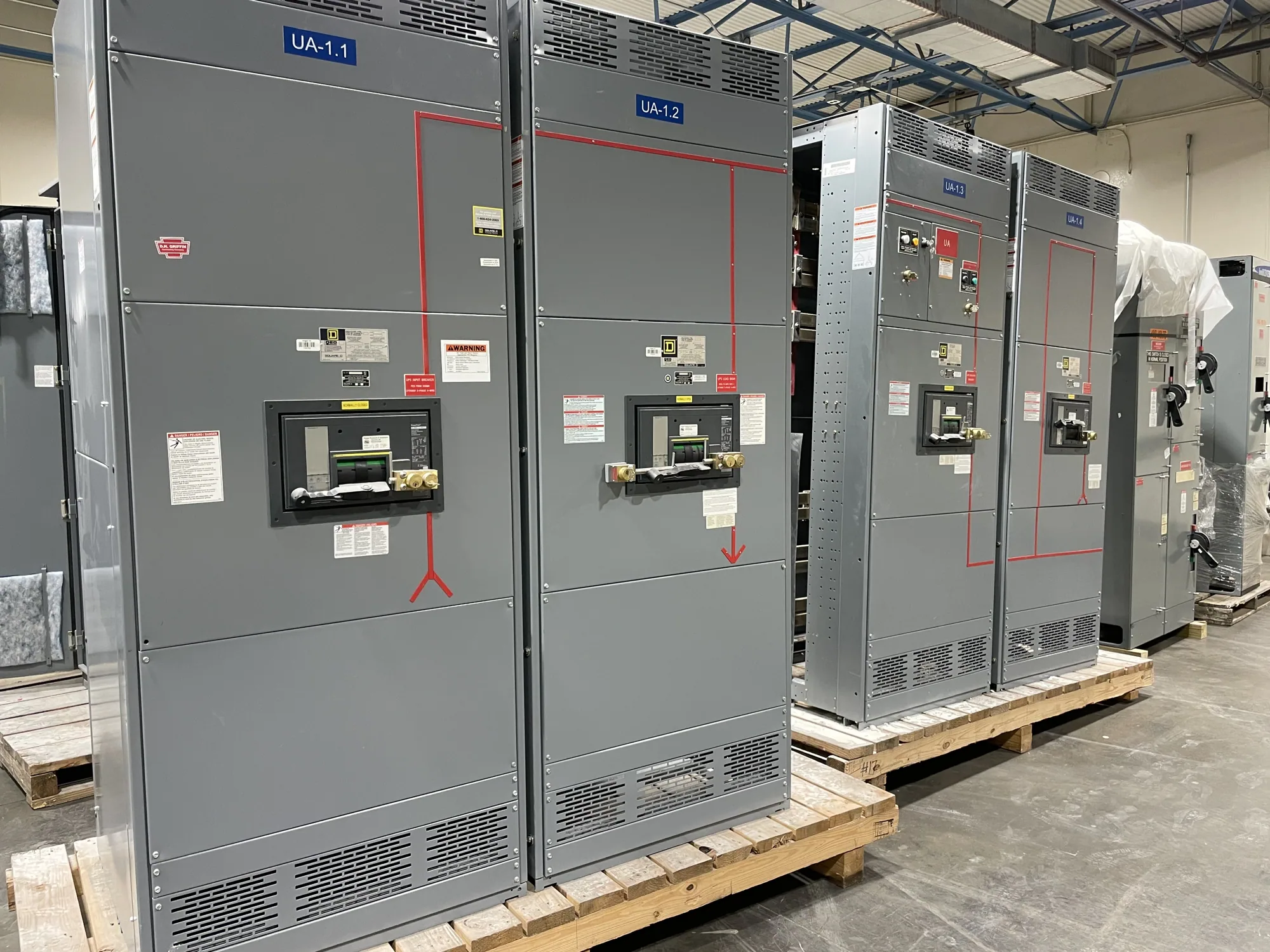
Plan distribution around the campus
A commercial campus may combine offices, retail or dining areas, shared amenities, and buildings added at different times. Those uses can create different load profiles and operating schedules. A switchboard is part of the low-voltage distribution system: it can receive service power and distribute it through feeder devices to downstream panels or other equipment. The appropriate arrangement depends on the electrical design, the utility and service configuration, and the needs of each building.
Start by mapping the distribution path, not by assuming one large board serves every structure. Identify which switchboards are planned at each service point, what loads they supply, and where feeders run between them. This clarifies whether the purchase scope is a main service board, a feeder-distribution board, or multiple assemblies with distinct roles. It also helps the project team coordinate equipment boundaries, metering, and responsibility for downstream distribution.
Choose service and feeder arrangements deliberately
Service devices and feeder devices serve different parts of the distribution scheme. Their quantity, type, and ratings should follow the approved one-line diagram and project specifications. For a campus, consider how tenant spaces, common areas, central mechanical equipment, and future building phases are assigned to feeders. A layout that makes those circuits identifiable and accessible can support planned isolation and operational clarity, but switching procedures and operating responsibility remain matters for the facility team and qualified personnel.
Metering needs should be resolved early. Determine whether the project calls for a service meter, individual tenant metering, submeters, or provisions for future measurement, and confirm who supplies each component. Metering arrangements affect board sections, device placement, wiring interfaces, and available space. Likewise, ask whether a feeder must serve a separately controlled building or a future phase. These are design questions for the responsible electrical engineer; do not treat an assumed campus arrangement as a universal requirement.
Coordinate dimensions, access, and construction phases
Switchboard dimensions and section configuration need to work with the electrical room and installation route. Provide room dimensions, door and corridor clearances, ceiling conditions, floor or housekeeping-pad details where specified, and the planned equipment location. Confirm access for assembly placement and future service, along with the working-space requirements established by the project design and applicable rules. Manufacturer drawings should be coordinated with the room and building plans before construction fixes the available space.
Phased construction can make the interface between current and future work important. Show which feeders and sections belong to the first phase, what later connections are anticipated, and whether a future addition will involve a new board or changes to existing distribution. The design team should evaluate outage windows, temporary power needs, and how tie-ins can be sequenced. Do not assume spare capacity, a future connection point, or a particular expansion method unless it is explicitly included in the approved design and equipment scope.
Verify continuous-current and fault requirements
Continuous-current selection begins with the expected loads and the design assumptions behind them. Gather calculated demand, operating schedules, load types, and any documented allowance for planned growth. The responsible engineer should establish the required continuous-current ratings for the bus and each service or feeder device, and determine whether applicable ambient temperature, enclosure conditions, loading patterns, or other specified factors affect selection. A bus rating and a breaker rating are related to the system design but are not interchangeable.
Fault requirements deserve separate confirmation. Provide the available fault-current information at the proposed point of connection and the protection and coordination study criteria, where available. The engineer and manufacturer must verify that the specified assembly and its components are suitable for the project conditions; do not infer a fault rating from a current rating or from a similar installation. Equipment ratings, protective-device choices, and any required labeling depend on the final design and must be confirmed for the actual assembly.
Prepare a complete campus equipment scope
For a useful quotation, provide the latest one-line diagram, equipment schedule, project specifications, service and feeder device requirements, metering scope, and requested continuous-current and fault information. Include voltage and system details as stated in the design, the number and destination of feeders, enclosure and room constraints, and any defined future provisions. Identify the campus building and construction phase for each assembly. Flag unresolved items rather than filling gaps with assumptions, especially where utility coordination or a later phase could change the scope.
Also identify requested drawing submissions, review milestones, shipping destination, and the date the project team needs equipment information for coordination. South Carolina Switchgear Builders manufactures new switchboards to specification, with US-built equipment and all-American components, and ships nationwide. Short lead times may be available, but availability and the actual schedule depend on the order and must be confirmed. Review the proposal and drawings against the project documents before approving production.
Coordinate supply with engineering and installation
Manufacturer equipment supply is one part of a campus electrical project. The project’s responsible electrical engineer establishes system requirements and approves the design; the construction team coordinates room readiness, conduits, conductors, and installation sequencing. Installation, inspection, testing, and maintenance belong to qualified personnel following applicable safety procedures. Confirm in writing which party handles field connections, utility coordination, startup activities, and any site-specific work, since these responsibilities are not automatically included with a switchboard purchase.
When the scope, interfaces, and ratings are documented, the buyer can compare equipment proposals on a consistent basis and reduce avoidable revisions during phased construction. Keep the one-line diagram, specifications, room information, and schedule aligned as the design develops. Before releasing an order, resolve open questions about metering, feeder assignments, access, fault conditions, and future provisions with the responsible project team. That disciplined review gives the manufacturer a clearer basis for configuring the new campus switchboards to the project requirements.