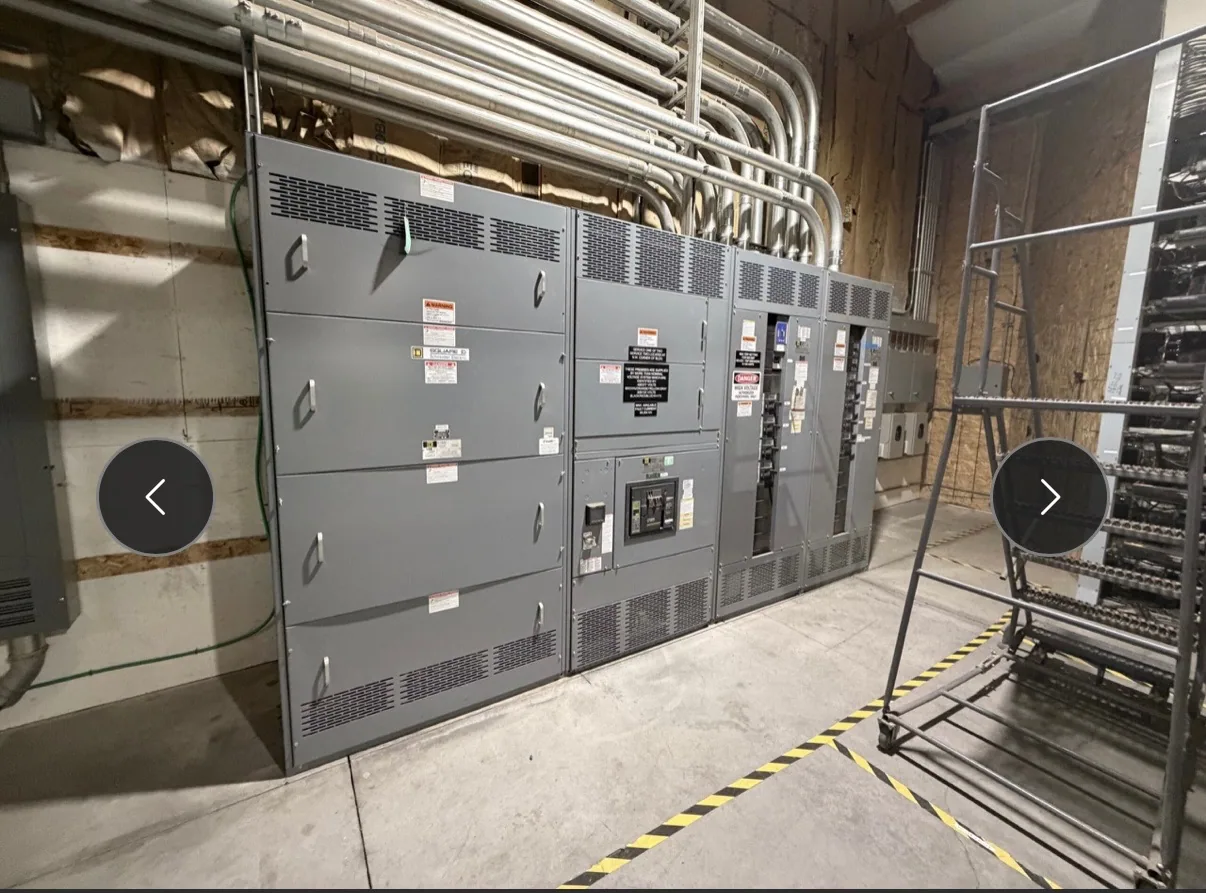
The essential difference
Short-circuit withstand and interrupting ratings describe related but distinct capabilities. A withstand rating applies to equipment or an assembly that must tolerate short-circuit current for a stated duration under specified conditions. An interrupting rating applies to a protective device, such as a circuit breaker, and describes its ability to interrupt fault current within its rated application. One addresses surviving the event; the other addresses clearing it.
These terms are not interchangeable, and a larger number in one category does not automatically establish a suitable rating in the other. A switchgear lineup, switchboard, breaker, and other components may each have ratings with different meanings and conditions. The applicable values and how they coordinate must be confirmed for the actual design, system voltage, protective devices, and project requirements.
What an assembly withstand rating means
When a fault occurs, current can produce intense heating and mechanical forces. An assembly withstand rating indicates that the specified equipment is designed to tolerate a stated short-circuit current for a stated time, subject to the applicable configuration and conditions. It does not mean the assembly is intended to clear the fault by itself or that it can endure fault current indefinitely.
For a low-voltage switchgear or switchboard project, the responsible engineer needs to consider the available fault current at the equipment location and the protective-device arrangement. The relevant assembly rating, duration, and any conditions on its use must match the specific design. Do not assume a rating applies unchanged if the lineup, breaker type, protection scheme, or installation details differ from the configuration evaluated.
What an interrupting rating means
An interrupting rating concerns the protective device’s ability to open a circuit and stop fault current under defined conditions. It is a property of the particular breaker or other interrupting device, not a general statement that every part of the switchgear assembly has the same capability. The device must be suitable for the system conditions in which it will be applied, as established by the project design and manufacturer documentation.
Interrupting capability also does not describe how long an assembly can withstand fault current before the device clears it. The clearing time depends on the protective-device selection and settings, along with the fault conditions. Engineers therefore review device ratings and operating characteristics alongside assembly withstand capabilities, rather than treating either value as a substitute for the other.
How the ratings work together
Consider a new low-voltage lineup connected to a source where the project engineer has determined the available fault current. A breaker is selected to interrupt the expected fault under its specified application, while the assembly is selected to withstand the current for the relevant duration until that device clears it. This is an illustrative relationship only; no rating or coordination result can be inferred without the project’s actual calculations and equipment details.
If the protective device’s interrupting rating is inadequate for the available fault current, the breaker may not be suitable for the application. If the assembly’s withstand capability is inadequate for the current and clearing time, the assembly may not be suitable even if the breaker has adequate interrupting capability. Both questions matter, and the final design must also account for any conditions or limitations associated with the selected equipment.
Common rating misunderstandings
A frequent mistake is reading a breaker rating as the short-circuit rating of the complete lineup. Another is assuming that an assembly withstand value proves that its protective devices can interrupt the same current. Neither conclusion follows automatically. Ratings belong to specific equipment and configurations, and their definitions, test basis, duration, and application conditions need to be reviewed in the relevant documentation.
Do not assume a rating can be increased after equipment is purchased by changing a breaker or adjusting a setting. A modification can affect the evaluated configuration and may require engineering review. Likewise, standards or listing references must be checked for the specific equipment and design. UL 891 applies to eligible low-voltage switchboards; applicability and assembly listing must be verified, and it should not be applied to medium-voltage switchgear.
Information to confirm for a project
Before requesting or reviewing equipment, gather the system voltage, the calculated available short-circuit current at the equipment location, and the protective-device information relevant to clearing the fault. Identify whether the requested product is low-voltage switchgear, a switchboard, or medium-voltage switchgear, and provide the intended configuration, incoming source details, and project specifications. The responsible engineer should identify required ratings and any applicable conditions.
Ask the manufacturer to confirm the proposed equipment’s assembly withstand capability, the interrupting ratings of the specified devices, the duration or application conditions associated with those values, and any configuration limitations. Also clarify which design documents, standards, or listing requirements apply. Availability, ratings, testing, and listing are specific to the supplied design and require confirmation; avoid relying on a generic product description alone.
Next steps for a sound selection
Use the two ratings as complementary checks: confirm that the protective device can interrupt the fault current, and that the assembly can withstand the specified current for the necessary period under the intended configuration. Share complete project information with the responsible engineer and equipment manufacturer early enough to resolve mismatches before finalizing the specification. Installation, testing, and maintenance should be performed by qualified personnel following applicable safety procedures.
A careful review ties the fault-current study, device selection, assembly configuration, and procurement documents together. If any input changes, such as the source arrangement or breaker selection, ask the project engineer to reassess the applicable ratings rather than carrying forward an unverified assumption. This keeps the equipment evaluation grounded in the actual system and the specific new assembly being considered.