Start with the project’s actual system voltage
Consider medium-voltage switchgear when the project’s electrical design includes medium-voltage distribution and requires equipment to control, protect or isolate that portion of the system. The trigger is not simply a large building, high demand, or a preference for particular equipment. The utility service arrangement and the engineered system voltage establish whether medium-voltage equipment belongs in the design.
Medium-voltage switchgear is distinct from low-voltage switchboards. For example, 5 kV and 15 kV class equipment is medium voltage, while 480 V class equipment is low voltage. Those examples identify voltage classes, not a universal cutoff for every system. Ask the project engineer to state the nominal voltage and equipment requirements rather than inferring them from facility size or a partial description.
Understand where the utility and owner systems meet
Review the utility’s documented service information alongside the project one-line diagram. Determine the service voltage, the point of delivery, and which equipment is within the utility’s scope versus the owner’s scope. A project may receive service at medium voltage and distribute power through medium-voltage equipment before transformers supply downstream low-voltage switchboards. The actual arrangement depends on the approved project design.
Do not assume that a utility’s nearby distribution voltage is the voltage offered to a specific project, or that a service description alone settles equipment selection. Confirm the service point, metering and protection responsibilities, available system data, and any utility requirements with the responsible parties. Manufacturer review can help assess a defined equipment specification, but it does not replace utility coordination or the engineer’s design authority.
Follow the one-line through each distribution stage
Trace power from the service entrance through transformers, distribution sections, and major loads. Identify where the design changes voltage and which devices must switch, protect, or isolate each section. Medium-voltage switchgear may be considered at a medium-voltage service entrance or at another engineered medium-voltage distribution point. A low-voltage switchboard may serve downstream circuits after transformation; it is not a substitute for medium-voltage gear where the system requires medium-voltage equipment.
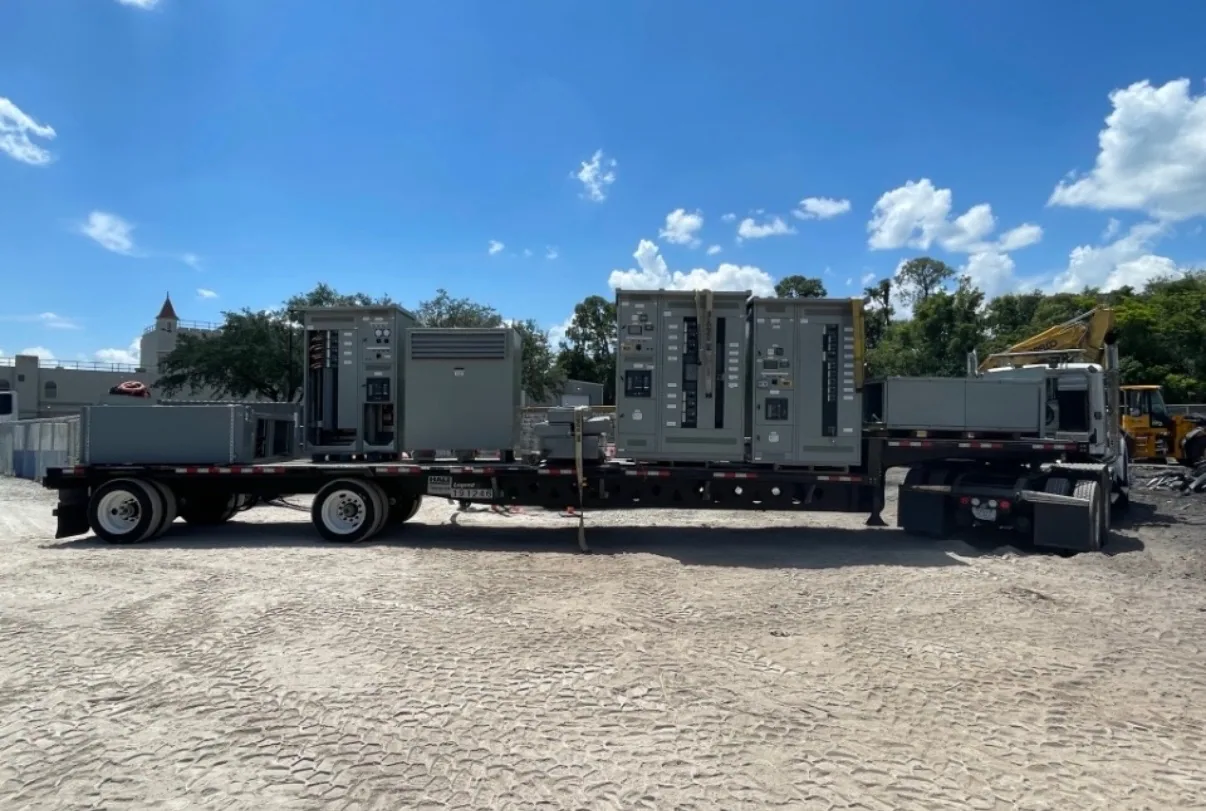
For an illustrative case, a facility’s design might show medium-voltage service, a medium-voltage lineup, transformers, and 480 V distribution switchboards. That arrangement makes both product categories relevant for different parts of the system. It does not establish that every facility with substantial loads needs medium-voltage switchgear. The engineer must assess the actual service, load plan, distribution topology, protection approach, and project constraints.
Weigh design tradeoffs without guessing
System voltage affects the equipment specification and how the distribution design is organized. Other project considerations may include the number and purpose of incoming and outgoing circuits, switching and isolation needs, protection functions, physical layout, access, environmental conditions, and planned expansion. These are design questions, not reasons to select a lineup by general rule. The project engineer should define requirements and resolve tradeoffs before procurement.
Compare the complete medium-voltage option with the complete alternative, including any transformation and low-voltage distribution equipment required. Review equipment boundaries, space and connection arrangements, coordination, and the responsibilities of the utility, engineer, installer, and manufacturer. A change in service voltage or system topology can change the equipment scope, so verify assumptions early rather than treating a preliminary equipment label as a final specification.
Clarify ratings, configuration, and isolation
Ask the responsible engineer to identify the nominal system voltage and specify the applicable equipment ratings and functions. The manufacturer needs the project’s defined requirements to evaluate a suitable custom-to-specification configuration. Confirm which ratings, construction details, protective devices, metering provisions, and internal or external interfaces apply to the actual design. Do not assume a product’s voltage class alone establishes its suitability for a particular installation.
Isolation deserves a specific discussion: which sections need to be isolated, for what operating or maintenance purpose, and how the project’s safety procedures address that work. Requirements depend on the design and selected equipment. Installation, testing, and maintenance must be performed by qualified personnel following applicable safety procedures; no equipment selection should be treated as authorization for energized work.
Prepare useful information before requesting equipment
Provide the current one-line diagram, utility service documentation, nominal system voltage, project scope, and the intended boundary between utility and owner equipment. Include the required incoming and outgoing circuits, specified ratings, protection and metering requirements, physical and environmental constraints, and any interfaces with transformers or downstream switchboards. Identify items still awaiting engineering or utility confirmation so they are not mistaken for settled requirements.
Ask what design details, listing or testing requirements, and delivery assumptions need confirmation for the specified assembly. Applicability depends on the actual equipment and project specification; do not presume a standard or listing applies to every configuration. For new equipment, South Carolina Switchgear Builders manufactures US-built switchgear and switchboards with all-American components and ships nationwide. Configuration and availability are order-specific, and actual lead times and delivery dates must be confirmed.
Make the decision with the project team
A practical next step is to have the engineer confirm the utility service voltage, map the distribution stages on the one-line, and identify where medium-voltage switching and protection are required. Then align the equipment specification with the project’s ratings, interfaces, space, isolation objectives, and procurement schedule. If those details are unresolved, record them as open questions and coordinate with the utility and design team before finalizing the purchase scope.
In short, consider medium-voltage switchgear when the engineered system includes a medium-voltage distribution point that requires the functions and equipment specified for it. Do not choose it solely because a project is large, and do not replace it with a low-voltage switchboard where the design calls for medium-voltage gear. A verified one-line and coordinated specification provide the sound basis for selecting new equipment.