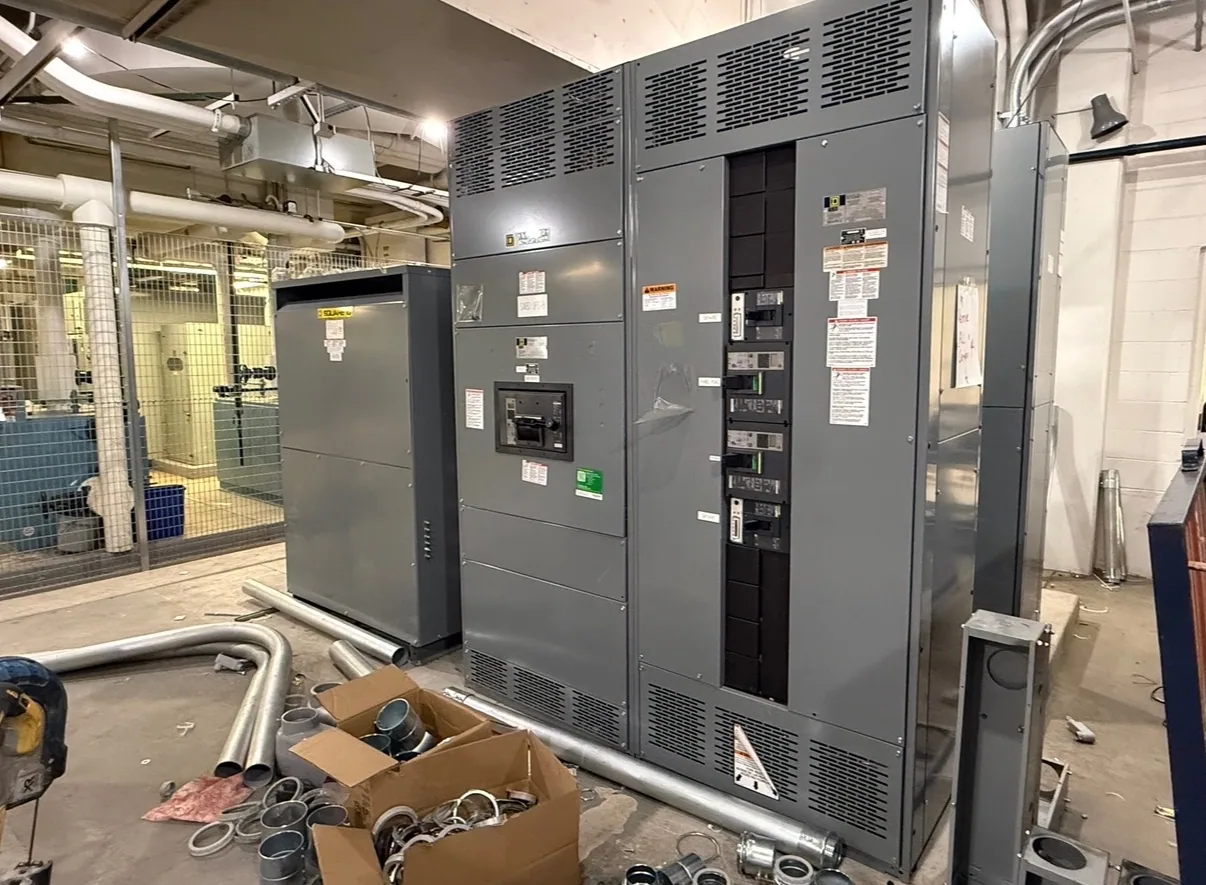
Distribution needs across a water facility
Water and wastewater facilities combine electrical loads that operate at different points in a process. A site may include raw-water or lift-station pumps, treatment equipment, process controls, ventilation, and buildings with lighting and general services. The distribution design must reflect how these loads are grouped, where they are located, and which functions need coordinated operation. A useful equipment discussion begins with the one-line diagram and the facility’s operating objectives, not a generic equipment label.
Remote pump stations and outdoor process areas add practical coordination needs. Equipment location, cable routes, access for qualified workers, enclosure requirements, and environmental exposure should be reviewed for each installation. Conditions may include moisture, washdown, corrosive agents, temperature variation, or airborne contaminants, but their presence and severity should be established by the project team. The selected assembly and its enclosure details must match the specified site conditions.
Motor loads, starting, and distribution architecture
Large motor loads can shape feeder and source decisions. The engineer should identify motor horsepower, starting method, operating sequence, expected simultaneous operation, and any variable-frequency drives or soft starters. Starting current and the effect of starting on the electrical system depend on the motor and control design. Avoid choosing switchgear solely from connected load totals; confirm the intended operating cases, protective-device coordination, and available fault-current information with the responsible engineer.
Low-voltage switchgear may be appropriate where the facility’s distribution system and equipment ratings support it. A 480 V class assembly is low voltage. Medium-voltage switchgear, including 5 kV and 15 kV class equipment, may be considered where the project’s source, distribution arrangement, and loads call for that class. These are not interchangeable product categories, and no voltage choice should be inferred from facility type alone. Confirm the nominal system voltage and all required equipment ratings against project documents.
Voltage and system details to resolve
Voltage selection involves more than matching a number on a nameplate. The project team should distinguish nominal system voltage from the equipment’s specified maximum voltage and verify insulation requirements, grounding method, frequency, phase, and system configuration. Source characteristics and the distribution topology also matter. Ask the engineer to identify applicable fault-duty requirements and protection assumptions; the manufacturer needs the project-specific values and configuration to evaluate an assembly for the intended application.
For a facility with multiple buildings or remote loads, clarify where the electrical service transitions between voltage classes and which equipment is included in the procurement package. Determine whether the scope covers a main distribution assembly, feeder sections, or defined interfaces with separate motor-control and process-control equipment. Naming the voltage class is a starting point, not a complete specification. Ask the project engineer to resolve any mismatch between drawings, equipment schedules, and procurement language before an order is finalized.
Environmental exposure and controls integration
Corrosion protection should follow a documented site assessment rather than assumptions based on the word “water.” Identify indoor and outdoor locations, expected moisture or chemical exposure, enclosure placement, ventilation needs, and maintenance access. The project specification should state relevant enclosure and material requirements for the actual environment. Confirm that the chosen design, options, and installation arrangement address those conditions; environmental suitability cannot be established from a product category alone.
Control integration also deserves early attention. The facility team should identify required status and alarm points, communications interfaces, interlocks, and the division of responsibility among switchgear, motor controls, drives, and process automation. Confirm interface details with the controls designer and equipment suppliers, including wiring and documentation expectations. Clear boundaries reduce ambiguity during submittal review and installation, especially where equipment is distributed among a central plant and remote stations.
Prepare a complete equipment inquiry
Before requesting pricing or a proposed configuration, assemble the current one-line diagram, load and motor schedules, voltage and grounding information, and available fault-current data. Include the intended equipment location, environmental requirements, required ratings, and project standards. Identify whether drawings or specifications are preliminary, who can approve deviations, and what documentation the purchasing team needs. A focused request-for-quotation checklist helps expose missing inputs without treating unresolved engineering decisions as settled.
Owners, engineers, and purchasing staff should also clarify scope, quantity, requested submittals, inspection or testing expectations, delivery destination, and schedule constraints. Ask which design details require confirmation before release and how changes will be handled after review. Listing, testing, ratings, and standards are specific to the proposed equipment and must be verified against its actual specification. Availability and lead time depend on the order and should be confirmed rather than assumed.
Coordinate selection through procurement
South Carolina Switchgear Builders manufactures new switchgear and switchboards in the United States, using all-American components, with configurations custom to specification and nationwide shipping. The appropriate equipment, applicable listing, and delivery schedule depend on the project details and require confirmation. For a water or wastewater project, share the engineering basis and operating context early so the proposed scope can be evaluated against the facility’s distribution plan.
Keep the engineer, owner, controls team, and purchasing contact aligned through specification review, submittals, and order release. Resolve voltage class, environmental criteria, motor and protection assumptions, and control interfaces before treating the configuration as final. Qualified personnel must perform installation, testing, and maintenance under applicable safety procedures. With clear inputs and defined responsibilities, the project team can make a more informed equipment decision and coordinate procurement without relying on unsupported assumptions.