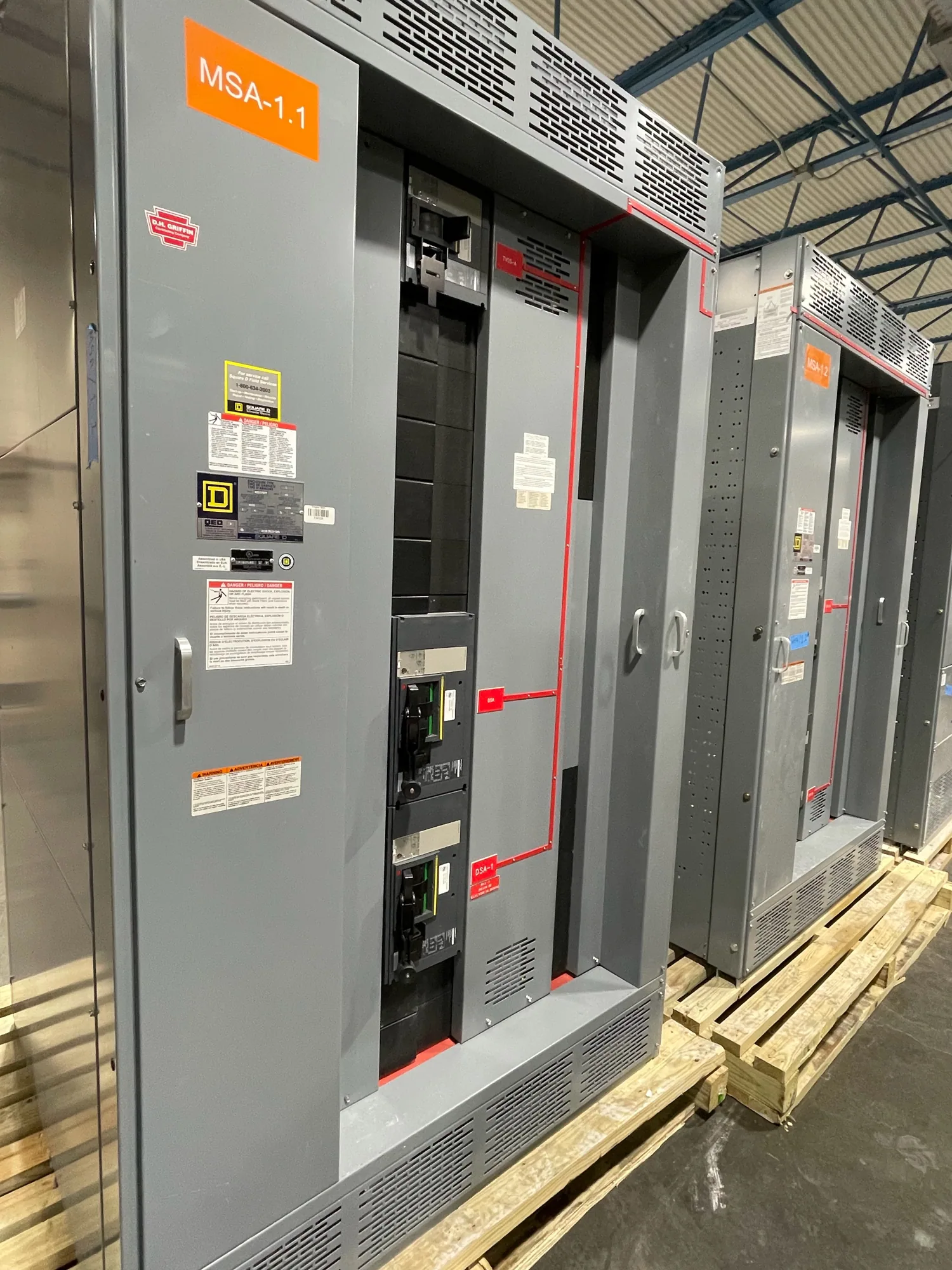
Why ratings matter across a food facility
Food and beverage plants combine refrigeration, process motors, packaging lines, conveyors, pumps, and building services. Those loads may connect through several distribution levels, each with different equipment and operating conditions. Short-circuit ratings help establish whether specified equipment can withstand or interrupt the fault conditions relevant to its location. The appropriate value is not one facility-wide number: the engineering analysis must consider available fault current at each point in the system.
For an owner planning new equipment, the goal is to give the engineer and manufacturer a consistent design basis. A rating selected without the system study, source information, and equipment configuration can be unsuitable even if it appears ample on a schedule. Conversely, specifying an unnecessarily high rating may affect equipment selection, footprint, cost, or coordination. The responsible electrical engineer should confirm the required ratings from project-specific calculations and applicable requirements.
Understand the rating at each system point
Available fault current depends on the electrical source and the impedance between that source and the equipment location. Utility or on-site generation details, transformer data, conductor lengths and sizes, and system arrangement can all matter. Operating configurations may also change the analysis; for example, alternate feeds or parallel sources should be identified for review rather than assumed to be irrelevant.
Equipment schedules and submittals may refer to interrupting capacity, short-circuit current rating, or withstand capability. These terms describe related but distinct performance questions, and their meaning depends on equipment type and applicable standards. The design team should identify what rating applies to each assembly and protective device, how it was established, and whether the proposed configuration supports it. Do not treat a component rating as proof of an entire assembly rating.
Account for motors and process operation
Large compressors, pumps, fans, and process motors are important inputs to a fault-current study. Their characteristics and connections can influence calculated conditions, while the starting and operating requirements shape feeder and protective-device choices. Provide motor schedules with relevant nameplate and application information, drive details where applicable, and expected operating arrangements. The engineer can determine which contributions and scenarios belong in the analysis.
Continuity goals also affect decisions. A fault or maintenance event involving a refrigeration train, packaging area, or shared process bus may have different operational consequences from one affecting a noncritical load. Identify essential loads, planned isolation boundaries, standby sources, and any desired separation between production areas. These priorities inform system architecture and protective-device coordination, but they do not replace verifying each device and assembly against the calculated fault conditions.
Include sanitation and environmental interfaces
Washdown practices, cleaning chemicals, moisture, temperature, dust, and room ventilation can affect enclosure and installation requirements. Describe where equipment will be located, how cleaning is performed nearby, and whether spray, condensation, or corrosive exposure is expected. The design team should specify suitable environmental protection and confirm that enclosure choices, cable entry, clearances, and access arrangements fit both the electrical design and the sanitation plan.
Equipment ratings alone do not establish suitability for a food-production environment. Consider how electrical rooms or process-area installations interface with hygiene zones, drainage, cleaning routes, and maintenance access. Coordinate locations and boundaries with facility, sanitation, engineering, and operations stakeholders. Avoid assumptions that a standard enclosure or a particular switchgear arrangement is acceptable without reviewing the actual exposure and project requirements.
Coordinate protection and equipment interfaces
Protective-device selection and coordination should be reviewed alongside short-circuit ratings. The engineer evaluates how devices respond to fault conditions and whether their settings and characteristics support the intended system operation. Selective coordination may be a project objective for particular loads or systems, but it is not automatic. Provide the one-line diagram, device data, and operating modes so the responsible engineer can assess the desired outcome and its tradeoffs.
Medium-voltage switchgear may serve as an interface in some facility systems, but it is not required in every food or beverage plant. Where it is considered, its specified voltage class, source conditions, protective devices, and connection to downstream distribution must be reviewed as part of the complete design. Low-voltage switchboards and other assemblies require their own project-specific ratings and verification. Listing, testing, standards, and ratings should be confirmed for the actual equipment configuration rather than presumed from product category alone.
Prepare a useful equipment request
Before requesting a proposal for new equipment, assemble the current one-line diagram, fault-current study or design basis, voltage and system configuration, and available source and transformer information. Include equipment location and environmental conditions, load and motor schedules, protective-device preferences, and any known future expansion. Identify assumptions that remain open, along with the engineer responsible for confirming them. Clear inputs help the manufacturer evaluate the requested configuration without substituting guesses for engineering decisions.
Ask suppliers to identify the ratings and standards applicable to the proposed assembly, note design assumptions, and flag information needed to complete review. Confirm dimensions, access, cable entry, interfaces, and scope responsibilities with the project team. Availability and lead times depend on the order and should be confirmed; delivery planning should align with approved drawings, site readiness, and construction sequencing.
Review the design before release
Use a coordinated review among the owner, electrical engineer, facility operations, sanitation stakeholders, contractor, and equipment supplier. Confirm that the fault-current basis matches the current system configuration, that specified equipment ratings correspond to their locations, and that environmental and operational requirements are addressed. Resolve open assumptions before approving final drawings or releasing equipment for manufacture. Installation, testing, and maintenance should be performed by qualified personnel following applicable safety procedures.
This process connects electrical calculations to production realities without treating any single rating as a substitute for system design. With reliable source data, clearly stated operating priorities, and early review of environmental interfaces, a food and beverage project can specify new distribution equipment on a defensible, coordinated basis.