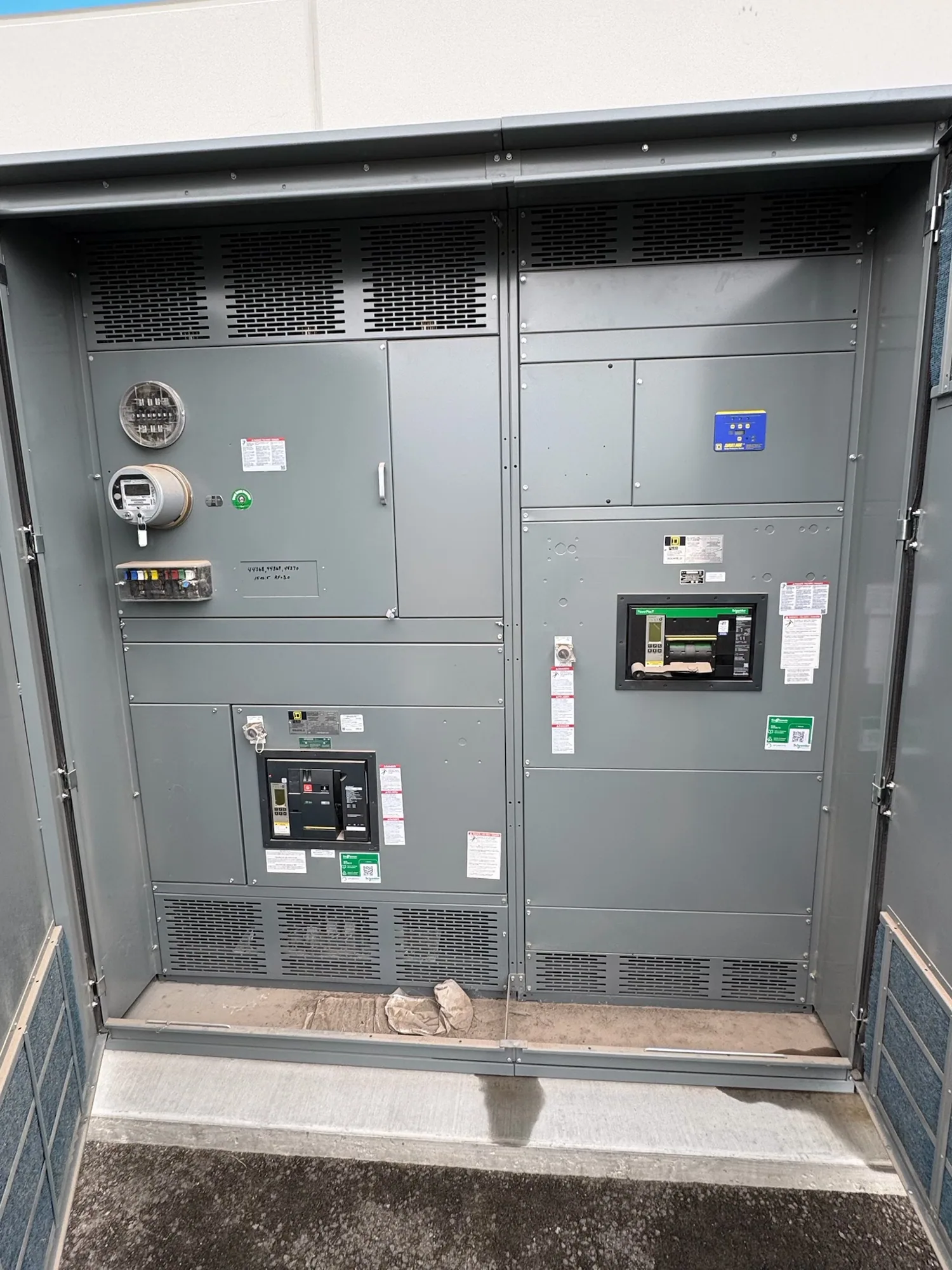
Start with the facility and its operating plan
Warehouse and logistics projects rarely have one uniform electrical environment. A distribution building may combine conveyor systems, sortation equipment, refrigeration, offices, loading areas, vehicle charging and outdoor utility interfaces. The right equipment arrangement depends on the actual installation locations and operating assumptions—not simply the facility’s industry label. Identify which loads are present today, which are planned, and how operations may change across project phases.
For each electrical room or outdoor equipment area, document its location, enclosure setting, access route and relationship to process areas. Note whether equipment will be indoors, exposed to weather, near vehicle traffic, or adjacent to spaces where dust, moisture or corrosive agents could occur. These observations help the project engineer define an appropriate specification for new switchgear or switchboards without assuming every part of a large site has the same conditions.
Record environmental conditions by equipment location
Temperature and humidity should be described for the specific room or installation area, including expected operating ranges and unusual seasonal or process-related conditions when known. Ask whether ventilation, heating, cooling or dehumidification is planned, and whether those systems are essential to maintaining the assumed environment. If the equipment location is not conditioned, communicate that fact early so the responsible engineer can determine what design provisions or operating limits need consideration.
Water exposure requires similarly specific description. Identify potential roof leaks, washdown practices, condensation, drainage paths, flooding concerns and the possibility of water entering through doors or cable routes. Where coastal air, road salt, industrial chemicals or other corrosive exposures may be relevant, describe the source and location rather than applying a broad label to the entire site. The equipment supplier should receive the project’s documented conditions and confirm what the proposed design can address.
Provide site elevation when known and flag unusual altitude or other environmental conditions for engineering review. Also describe dust, airborne fibers, exhaust or similar contaminants if they may reach an electrical room. These details are not substitutes for the project specification: they allow the engineer and manufacturer to identify design-dependent questions and confirm applicable ratings, enclosure features and other requirements for the particular assembly.
Plan feeders around load growth and charging assumptions
Conveyors, automated storage, sortation and building systems can have different operating schedules and demand patterns. Provide connected-load information, expected operating modes, starting or cycling characteristics where relevant, and the assumptions used for demand calculations. Identify loads that are critical to operations and any known sequence for bringing equipment online. The project engineer should establish feeder and distribution requirements from the full system design rather than from a generic warehouse allowance.
Vehicle charging plans need clear assumptions too. Share the anticipated charger quantity and types, charging schedules, diversity or managed-charging approach, and the phases in which infrastructure may be added. If these details are unsettled, state what is known and what remains provisional. A future-ready arrangement may involve reserved space or planned feeder provisions, but those choices have consequences for equipment dimensions, initial cost, protection coordination and the amount of capacity installed now. Confirm each trade-off with the responsible engineer.
Coordinate space, access and staged construction
Room dimensions, door openings, turning paths and equipment placement affect delivery, installation and future access. Provide current plans showing walls, structural obstructions, cable entry areas, working space assumptions and nearby equipment. Ask the project team to verify required clearances and access under applicable rules and the selected design. Consider how maintenance personnel will reach compartments and how future sections or feeder work could be completed without obstructing warehouse traffic or essential operations.
Phased expansion can reduce disruption, but it needs a defined sequence. Identify which loads will be energized in each phase, what equipment must be installed initially, and whether later work will occur beside operating systems. The design team must determine safe boundaries, isolation arrangements, coordination requirements and construction responsibilities for each stage. Installation, testing and maintenance should be performed only by qualified personnel following applicable safety procedures; expansion planning must not depend on energized work.
Understand the equipment interface and specification
Medium-voltage switchgear may be relevant where the project’s distribution architecture calls for a medium-voltage interface, but it is not automatically required for every warehouse. The engineer should establish the system arrangement, voltage class, utility or upstream interface, protection approach and downstream distribution needs. A low-voltage switchboard and medium-voltage switchgear serve different roles; do not treat their terminology, ratings or applicable standards as interchangeable.
For any proposed assembly, confirm its required electrical ratings, configuration, environmental provisions, applicable standards and any listing or testing expectations against the project specification. Such details depend on the design and supplied equipment. For eligible low-voltage switchboards, UL 891 applicability and assembly listing must be verified for the specific design; that standard should not be applied to medium-voltage switchgear.
Prepare a project-ready information package
Before requesting a manufacturer’s proposal, assemble one coordinated package: single-line diagram, load schedule, site and room plans, environmental notes by equipment location, charging assumptions, phased load forecast, preferred cable entry, access constraints and the project schedule. Identify the responsible engineer and stakeholders who must review technical submittals, including facilities, operations, construction and electrical contractors as appropriate. Mark open questions clearly so estimates are not mistaken for final design inputs.
South Carolina Switchgear Builders manufactures new equipment to specification, builds in the United States using all-American components, and ships nationwide. Short lead times may be available, but availability and actual timing depend on the order and must be confirmed. Share the documented conditions and project milestones early; the manufacturer and project team can then clarify design assumptions, confirm the proposed configuration and coordinate submittal review, production planning and delivery around the facility’s actual requirements.