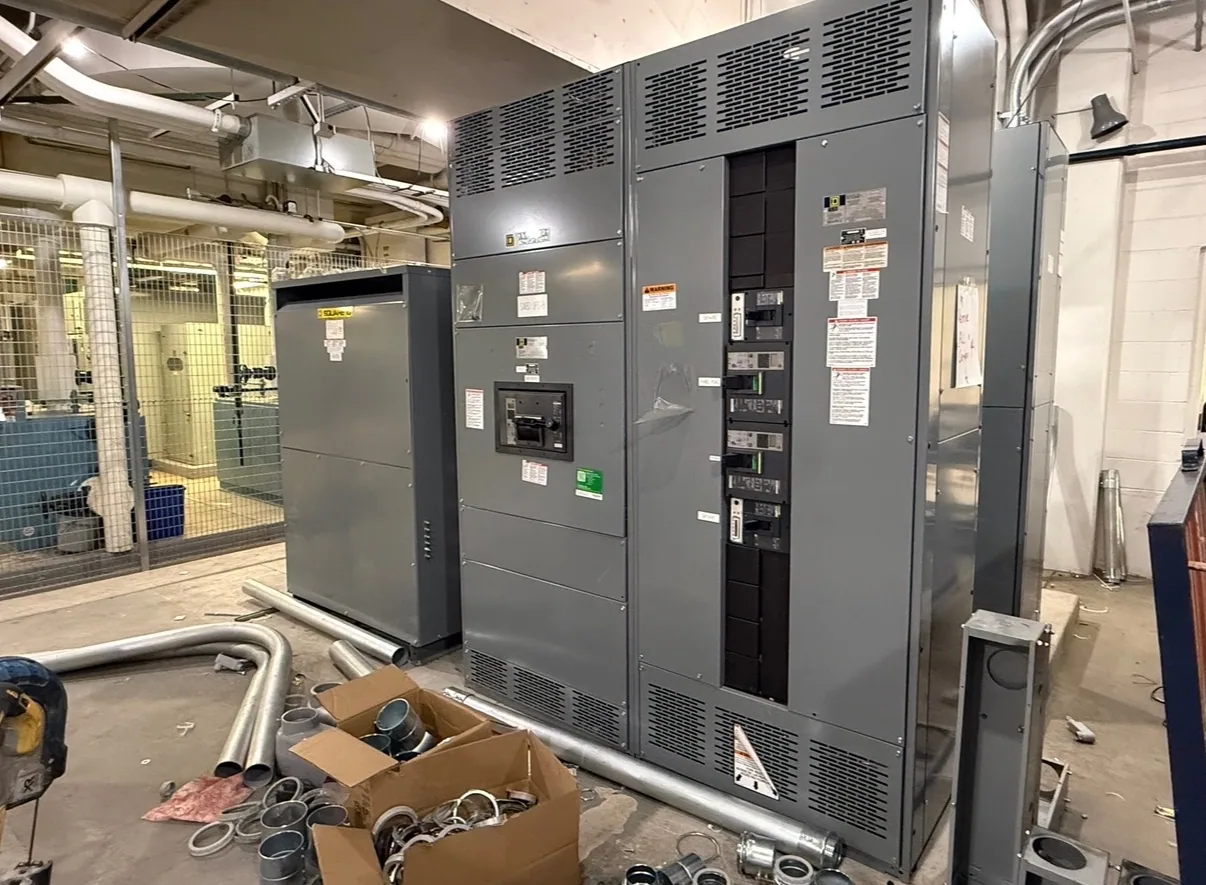
Define the busway’s role in the distribution system
Busway is a separate power-distribution product: an enclosed conductor assembly used to carry power along a planned route. Depending on the system design, feeder busway can connect a source to a downstream distribution point, while plug-in busway can provide approved locations for compatible tap-off devices. Neither function makes busway interchangeable with switchgear or a switchboard. Each has distinct construction, protection, and application requirements.
Start by mapping the electrical path and identifying every interface. A project might connect a switchgear or switchboard section to a busway run, then connect that run to another distribution assembly or loads through designated tap-offs. The responsible engineer should define the source, destination, voltage, phase and conductor arrangement, and required protective devices. Confirm how equipment terminals, transitions, and enclosures meet at each connection.
Size for load and available fault conditions
Continuous-current selection should follow the expected load, operating profile, applicable design requirements, and the manufacturer’s available configurations. Gather connected and demand load information, anticipated growth, and any known operating conditions that affect conductor selection. Avoid choosing a rating from a rough estimate alone: the complete assembly, ambient conditions, installation details, and connected equipment may influence the final specification.
Short-circuit capability is a separate, essential check. Provide the available fault-current information at the proposed busway source and identify upstream protective devices, including their specified characteristics. The engineer and manufacturers must verify that the busway’s fault rating and protection arrangement suit the actual system. A current rating by itself does not establish fault withstand, and a protective-device interface should not be assumed compatible without design confirmation.
Resolve routing, joints, and building coordination
Busway routing can offer a defined path through a facility, but the route must be designed around real building conditions. Submit dimensioned plans or coordinated models showing elevations, turns, offsets, penetrations, equipment locations, and access constraints. Record the intended route length and connection points, and identify areas where other trades, structural members, or future work may affect clearance and installation.
Expansion planning also matters. If loads or the facility layout may change, ask whether the selected arrangement can accommodate planned extensions or additional tap-off locations, and what components and shutdown boundaries those changes would require. Do not assume that an available plug-in opening is suitable for every device or load. Confirm permitted tap-off types, orientation, spacing, access, and protective-device requirements for the actual busway system.
Coordinate supports and installation responsibilities
Support spacing and attachment details depend on the busway design, route, building structure, and manufacturer instructions. Establish who will verify structural capacity, furnish support steel or hardware, locate anchors, and coordinate installation tolerances. Include vertical runs, seismic or other project-specific design criteria where applicable, and transitions near equipment. These items should be resolved before fabrication and field installation, not left to an assumed standard detail.
Clarify scope across the busway supplier, switchgear or switchboard manufacturer, electrical contractor, engineer, and construction team. Identify who supplies connection fittings, end closures, transitions, tap-off units, supports, and any required interface drawings. Confirm responsibility for field measurements, installation, inspection, and testing. Work on installation, testing, and maintenance belongs to qualified personnel following applicable safety procedures; never plan work on energized equipment.
Compare busway with other distribution approaches
Busway and cable-and-conduit distribution can serve different project needs. The choice may depend on route geometry, equipment locations, access for future changes, installation sequencing, and the project’s preferred construction method. Compare the complete installed design rather than a single component: include transitions, supports, protective devices, penetrations, coordination effort, and any required shutdowns for future modifications. The right answer depends on the facility and specification.
Keep the equipment boundaries explicit. Switchgear and switchboards house switching, protection, and distribution functions according to their specific design; busway carries power between designated points. A busway proposal should therefore document connection details and protective-device coordination without describing the busway itself as switchgear. If a project also needs new switchboards or other distribution equipment, coordinate their ratings and interfaces as a related but separately specified scope.
Prepare a complete busway inquiry
For a useful review, provide the one-line diagram, voltage and conductor requirements, load data, available fault-current information, upstream protection details, and the intended source and destination equipment. Add routing drawings with dimensions and elevations, support or structural criteria, environmental conditions, proposed tap locations, and any planned expansion. State the required product scope and identify which party will handle field verification and installation.
Also note project milestones, submittal expectations, delivery destination, and the equipment interfaces that must be coordinated. New configurations are custom to specification; availability and actual lead times depend on the order and should be confirmed during review. South Carolina Switchgear Builders manufactures and supplies new equipment, with US-built construction, all-American components, and nationwide shipping available as project details are confirmed. A complete inquiry lets the team assess fit, identify open engineering questions, and clarify what can be quoted.