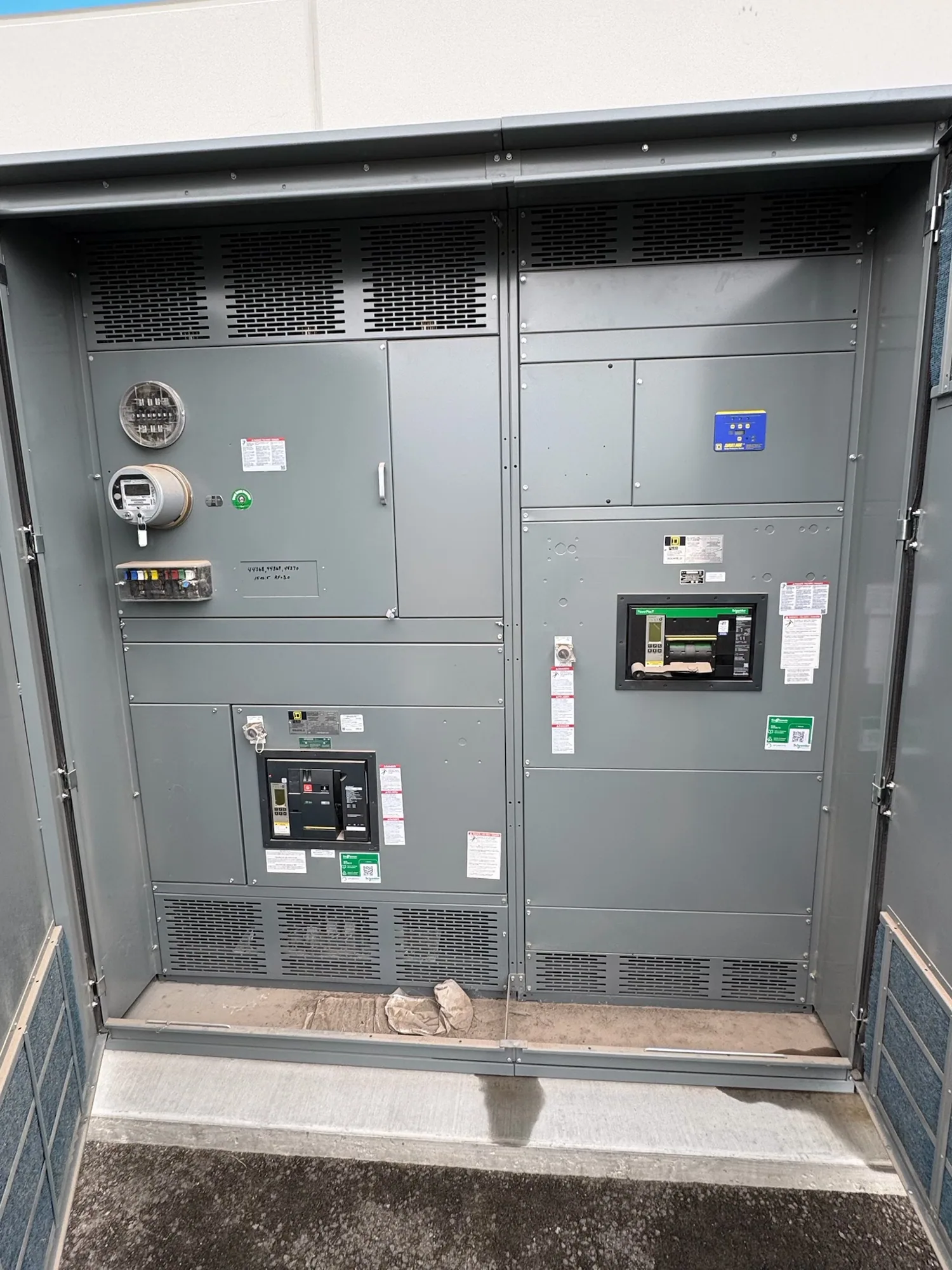
What a 1200 A designation tells you
For switchgear with a documented 1200 A continuous-current rating, the number identifies the applicable current rating of the specified assembly component under its stated conditions. Confirm whether it refers to the main bus, a main device, or another part of the equipment. A nominal rating alone does not establish how much load the installation may serve or whether the equipment suits a particular site.
Load calculations, conductor sizing, protective-device selection, equipment ratings, and applicable code requirements all inform the project engineer’s decision. The actual submittal and nameplate documentation should identify what is rated and any conditions or limitations. A 1200 A designation should not be treated as a substitute for reviewing those details against the project design.
Relate the rating to real project demand
Consider a hypothetical facility with several distribution feeders and a calculated demand that leads its engineer to evaluate a 1200 A main bus. That figure is a design input, not proof that the installation’s total connected load should equal 1200 A or that all feeders may carry their individual ratings simultaneously. The engineer must assess expected operation, demand, load characteristics, and the governing design criteria.
Provide the load schedule and explain which loads operate together, which are intermittent, and whether the project anticipates future additions. The responsible engineer can then determine how demand and operating assumptions relate to the bus and main protective device. Where planned expansion matters, describe it explicitly; choosing a larger rating without checking space, protection, and system coordination may not resolve the project’s actual constraints.
Separate bus, main, and feeder ratings
A switchgear assembly contains components with distinct functions and ratings. The main device controls and protects its associated circuit, while feeder devices serve individual outgoing circuits. A 1200 A bus rating does not mean every feeder is rated 1200 A, nor does it establish the permitted setting or rating of a main breaker. Those values must be specified and coordinated for the particular design.
List each feeder’s intended load, voltage, protective device requirements, and connection needs. The project engineer should confirm that the selected bus, main, feeder devices, conductors, and available compartments work together as an assembly. If there are many outgoing circuits, their number and arrangement can affect equipment configuration and footprint. Device positions, cable entry, and future provisions should be addressed before the layout is finalized.
Check fault duty and protection coordination
Continuous-current capacity is different from short-circuit capability. The available fault current and the project’s protective-device arrangement inform the short-circuit rating and equipment selection. A 1200 A current designation does not state how much fault current the assembly can withstand or interrupt. Obtain the project’s short-circuit study or the information needed for the responsible engineer to establish the applicable requirements.
Ask the equipment manufacturer to confirm that the proposed assembly documentation addresses the specified fault-duty requirements and device configuration. Coordination among protective devices may influence device choices and settings, which should be reviewed by qualified project personnel. Do not infer a short-circuit rating, listing, or coordination result from the 1200 A figure; each must be verified for the supplied design and its documented conditions.
Account for environment and room constraints
Rated performance depends on the specified equipment and the conditions for which it is designed. Share the intended installation environment, including relevant ambient conditions, indoor or outdoor application, and any exposure or enclosure requirements. The engineer and manufacturer can determine whether these conditions affect configuration or require further specification. Do not assume a rating applies unchanged under conditions that differ from the equipment documentation.
Room access and routing also matter when a multi-feeder lineup is planned. Provide available floor space, equipment access and working-space information, cable entry direction, and obstacles that could affect installation. These constraints may shape the lineup and feeder arrangement, but should not drive a selection that conflicts with electrical requirements. Confirm the final layout with the project team before release for manufacture.
Define the specification and review boundaries
A useful RFQ identifies system voltage, the intended meaning of the 1200 A rating, load schedule, main and feeder requirements, feeder count, and the available fault-current information. Include environmental conditions, enclosure needs, room dimensions, cable routing, and any planned expansion. If the project has required documentation, testing, listing, or standards, state them for confirmation against the proposed assembly rather than assuming they apply universally.
South Carolina Switchgear Builders manufactures new switchgear to specification, with US-built equipment, all-American components, and nationwide shipping. Availability and actual lead times depend on the order and must be confirmed. Provide complete project documents early so the manufacturer and responsible engineer can resolve rating, layout, and interface questions before equipment details are finalized.
Confirm the selection before procurement
Before approving a 1200 A design, have the project engineer verify calculated demand, bus and device ratings, feeder requirements, fault-duty information, installation conditions, and applicable code considerations. Review the manufacturer’s equipment documentation for the actual proposed configuration, including any project-specific ratings or conditions. Installation, testing, and maintenance must be handled by qualified personnel following applicable safety procedures.
This review turns a nominal current value into a coordinated equipment specification. With the load and feeder information, site constraints, and engineering requirements clearly defined, the project team can determine whether a 1200 A assembly is appropriate and identify what must be confirmed for the new equipment before ordering.